What if the thing promising you peace is the very thing keeping you from it?
I’ve been thinking about this a lot lately. Actually, I’ve been obsessing about it, if I’m honest. Which is ironic given the topic. But stay with me.
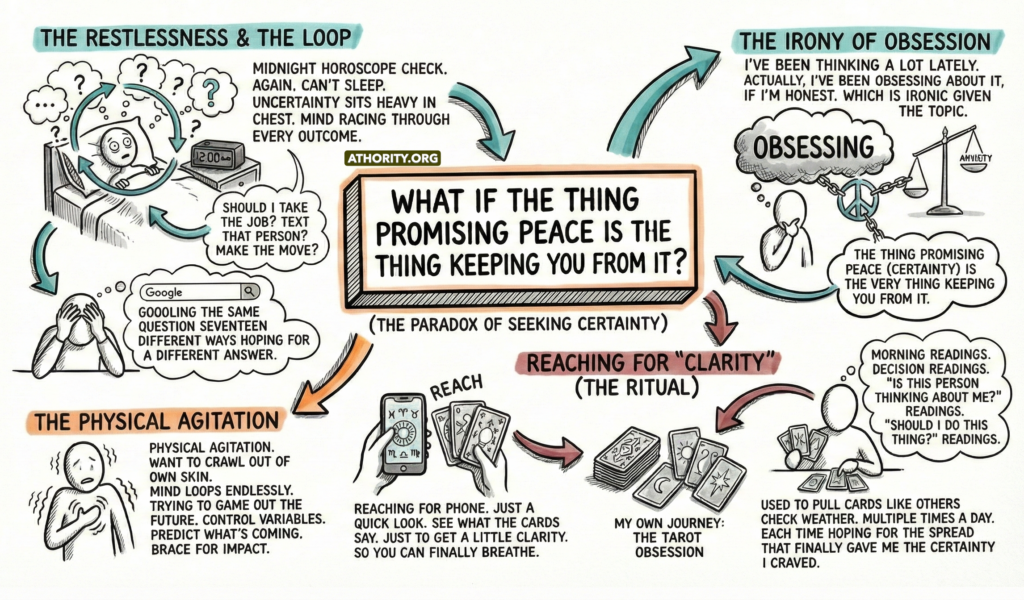
It’s midnight and you’re checking your horoscope. Again. (And honestly, who among us hasn’t Googled the same question seventeen different ways hoping for a different answer?) You can’t sleep because you don’t know if you should take that job. Or text that person. Or make that move. The not-knowing sits in your chest like something solid and heavy, and your mind won’t stop racing through every possible outcome, every permutation, every way this could implode.
So you reach for your phone. Just a quick look. Just to see what the cards say. Just to get a little clarity so you can finally breathe.
I know that restlessness. The physical agitation that makes you want to crawl out of your own skin. The way your mind loops endlessly, trying to game out the future, control the variables, predict what’s coming so you can brace for impact.
I used to pull tarot cards like other people check the weather… multiple times a day, sometimes. Morning readings. Decision readings. “Is this person thinking about me?” readings. “Should I do this thing?” readings. Each time hoping this would be the spread that finally gave me the certainty I craved.
When Knowing Feels Like the Only Way to Breathe
Here’s where this gets interesting, philosophically speaking. And I promise I’m going somewhere with this, even if it feels like a tangent.
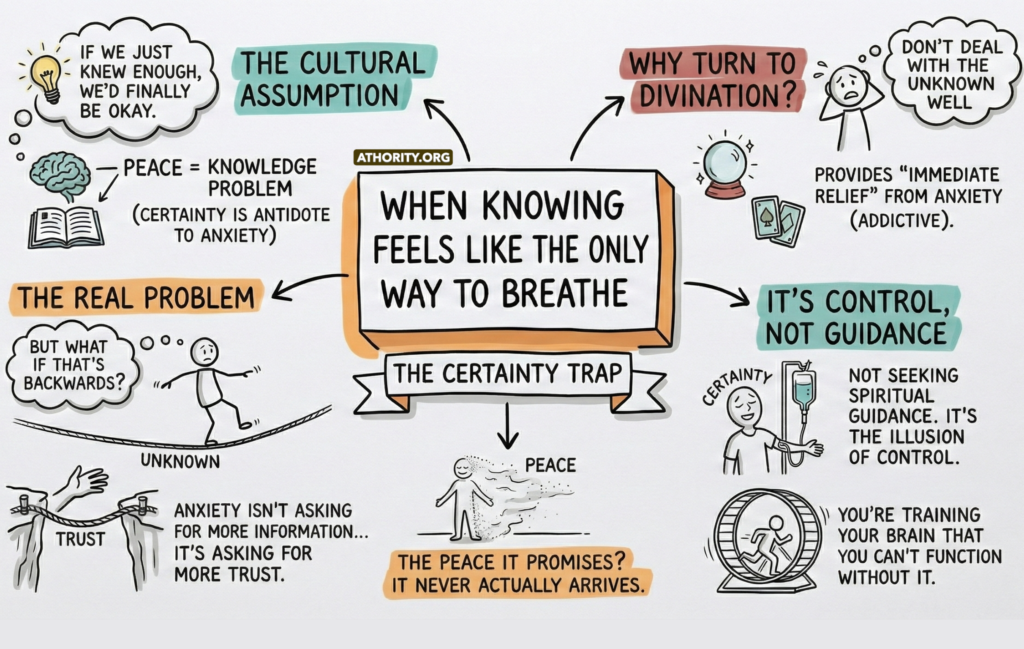
We operate under this assumption… and I mean we collectively, as a culture drowning in information… that if we just knew enough, we’d finally be okay. That peace is a knowledge problem, not a trust problem. That certainty is the antidote to anxiety.
But what if that’s backwards? What if the anxiety isn’t asking for more information… it’s asking for more trust?
People don’t turn to divination because they’re spiritually enlightened or even particularly interested in the occult. They turn to it because, as I’ve heard so many people put it, they “don’t deal with the unknown well.” They describe feeling “restless about a lot in life” and “constantly needing to know what will happen.” The divination provides “immediate relief” from the anxiety… which is exactly why it becomes addictive.
Terribly addictive.
It’s not spiritual guidance being sought. It’s control. The illusion that if you just have enough information, enough signs, enough readings, you can finally stop feeling so anxious about everything.
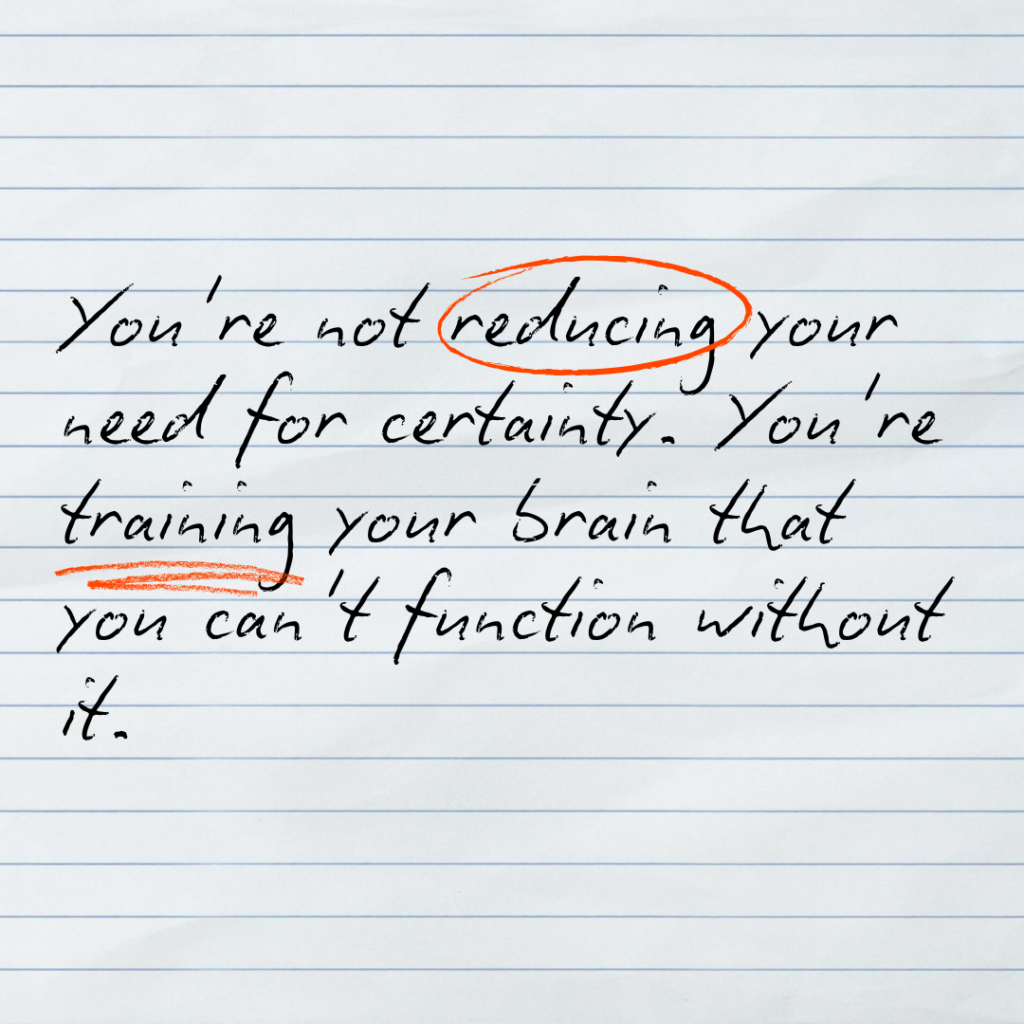
And this is the actual trap, not just the biblical warning everyone gives you about demons (though that’s real too, but we’ll get there)… the more you use divination to manage your anxiety, the more dependent you become on it. You’re not reducing your need for certainty. You’re training your brain that you can’t function without it.
The peace it promises? It never actually arrives.
When You Can’t Tell Your Intuition From Your Anxiety
I’ll be vulnerable here for a second. I lived in this cycle for… longer than I want to admit, honestly. Setting boundaries (“I’ll stop tomorrow”) and breaking them by noon. Googling “is tarot a sin?” for what was probably the hundredth time, hoping the answer had somehow changed. Feeling this physical restlessness that would drive me right back to the practices I knew weren’t right.
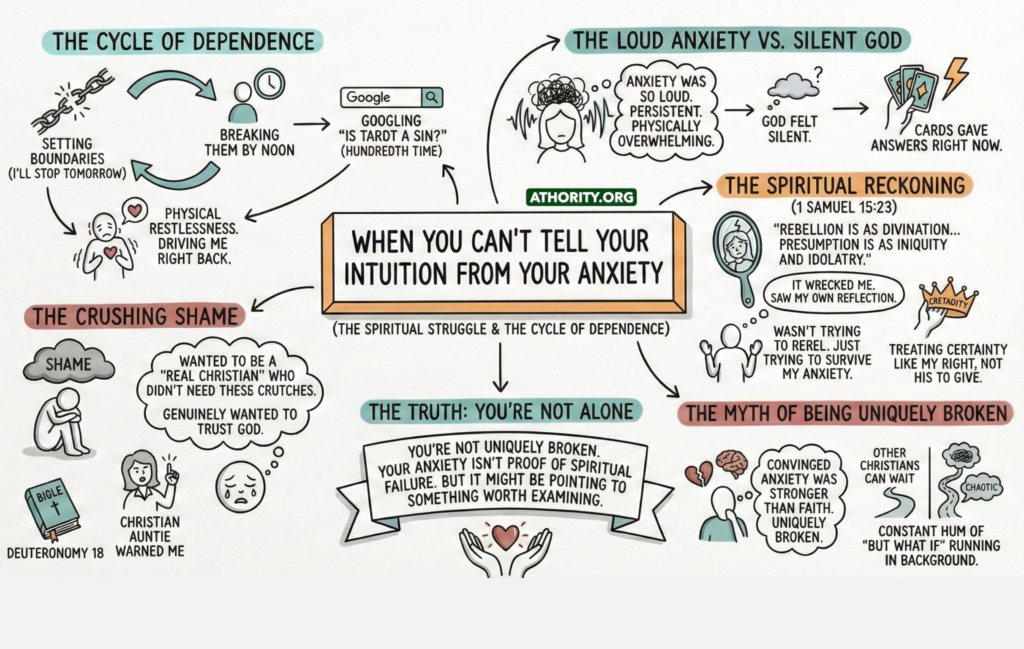
The shame was crushing. Because I knew what was said in church. My Christian auntie warned me. I’d read Deuteronomy 18. I knew these practices were condemned. I genuinely wanted to trust God. I wanted to be a “real Christian” who didn’t need these crutches.
But my anxiety was so loud. So persistent. So physically overwhelming that prayer felt inadequate. God felt silent. And the cards gave me answers right now.
I kept bumping into 1 Samuel 15:23, and honestly, it wrecked me. Not because someone was throwing it at me, but because I started to see my own reflection in it. “For rebellion is as the sin of divination, and presumption is as iniquity and idolatry” (1 Samuel 15:23, NLT). I wasn’t trying to rebel against God. I really wasn’t.
I was just trying to survive my anxiety. But somewhere in that desperation, I’d started treating certainty like my right rather than His to give.
But I was convinced my anxiety was simply stronger than my faith. That I was somehow uniquely broken in a way that made trusting God impossible. That other Christians could wait on the Lord because they weren’t wired like me… with this constant hum of “but what if” running in the background of every decision.
If you understand (put your hands in the air, lol just kidding), I want you to know: you’re not uniquely broken. And your anxiety isn’t proof of spiritual failure. But it might be pointing to something worth examining.
What Divination Actually Promises
What I eventually figured out, after way too much therapy and sitting uncomfortably with my own patterns, is that divination doesn’t fail because you’re doing it wrong.
It fails because it’s designed to fail.
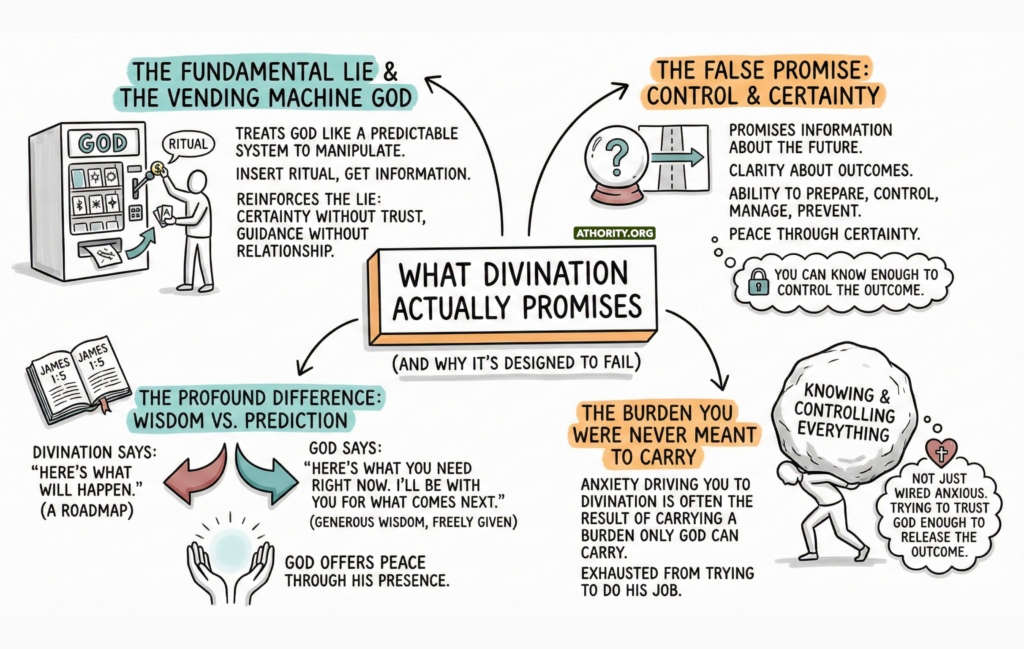
Think about it. What does divination actually promise? Information about the future. Clarity about outcomes. The ability to know what’s coming so you can prepare, control, manage, prevent.
It treats God like a vending machine. Insert the right ritual, pull the right cards, interpret the right signs, and out comes the information you need. It reduces Him to a predictable system you can manipulate for your benefit.
And when it works (or seems to), it reinforces the fundamental lie: that you can have certainty without trust, guidance without relationship, peace without surrender.
But God doesn’t work that way. “If any of you lacks wisdom, you should ask God, who gives generously to all without finding fault, and it will be given to you” (James 1:5, NLT).
Look at what that verse actually promises. Not certainty. Not knowing the future. Not a roadmap for every decision.
Wisdom. Generous wisdom. Freely given.
The difference is profound, and I’m still unpacking it myself. Divination says, “Here’s what will happen.” God says, “Here’s what you need to know right now, and I’ll be with you for whatever comes next.”
Divination says, “You can know enough to control the outcome.” God says, “You can trust Me enough to release the outcome.”
Divination promises peace through certainty. God offers peace through His presence.
And the anxiety driving you to divination in the first place? It’s not just your personality or your diagnosis or your weakness. It’s often the result of trying to carry a burden you were never meant to carry… the burden of knowing and controlling everything.
(Which, honestly, took me forever to see in myself. I thought I was just wired anxious. I didn’t realize I was exhausted because I was trying to do something only God can do. And I don’t say that to add to your guilt… because if you’re anything like I was, you have more than enough of that already.)
The Deeply Uncomfortable Part
I’m not going to lie to you. When I finally walked away from tarot and astrology, the anxiety got worse before it got better.
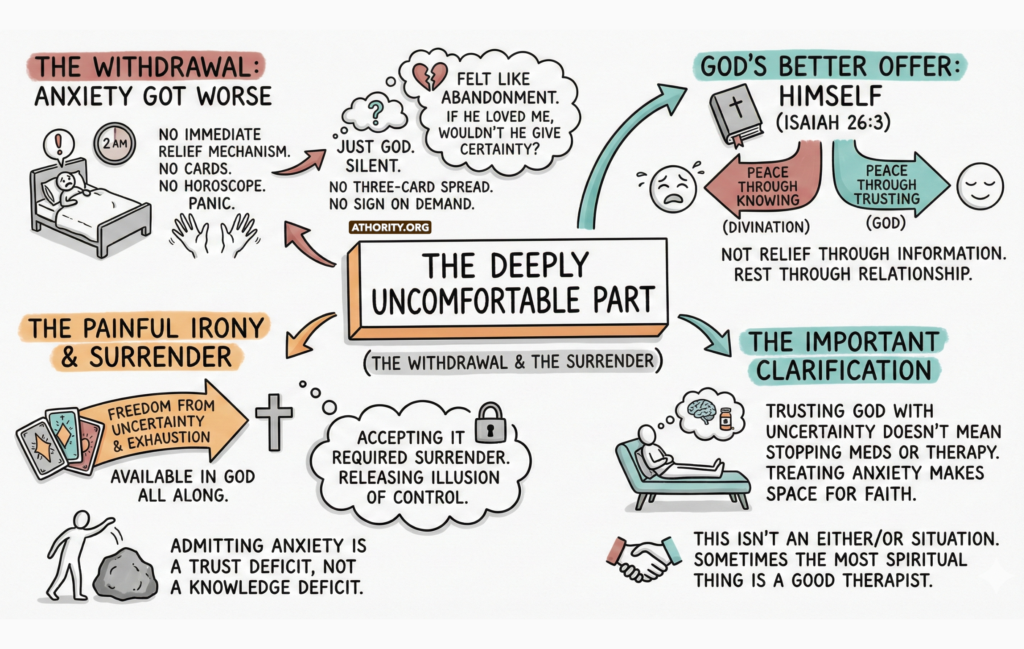
Because suddenly I had no immediate relief mechanism. No cards to pull when panic hit at 2 AM. No horoscope to check when I needed reassurance about a decision. Just… God. Who didn’t give me a three-card spread. Who didn’t send me a sign on demand. Who let me sit in the discomfort of not knowing.
At first, that felt like abandonment.
If He really loved me, wouldn’t He just tell me what to do? Wouldn’t He give me the certainty I needed to stop feeling so anxious?
What I’m slowly learning (and I mean slowly… this is not a neat testimony with a clean resolution): God wasn’t withholding guidance. He was offering something better than guidance.
He was offering Himself.
“You will keep in perfect peace all who trust in you, all whose thoughts are fixed on you!” (Isaiah 26:3, NLT).
Not peace through knowing. Peace through trusting.
Not relief through information. Rest through relationship.
The irony is almost funny if it weren’t so painful. What I was actually seeking through all those readings… freedom from the tyranny of uncertainty, rest from the exhaustion of trying to control everything… was available in God all along. But accepting it required the one thing divination had trained me to avoid.
Surrender.
And surrender doesn’t mean becoming passive or irresponsible or just “letting go and letting God” in some vapid, bumper-sticker way. It means releasing the illusion that you can know enough or control enough to guarantee the outcome you want. It means admitting that your anxiety isn’t actually about lacking information… it’s about lacking trust.
And no amount of readings can fill a trust deficit.
(And just to be clear here, because I think this matters… learning to trust God with uncertainty doesn’t mean you stop taking your meds or cancel your therapy appointments. If anything, getting my anxiety properly treated was part of what made space for faith to grow. Sometimes the most spiritual thing you can do is see a good therapist. This isn’t an either/or situation.)
Learning to Sit With Not Knowing
The hardest part of letting go of divination isn’t giving up the practice itself. It’s learning to be okay with not knowing.
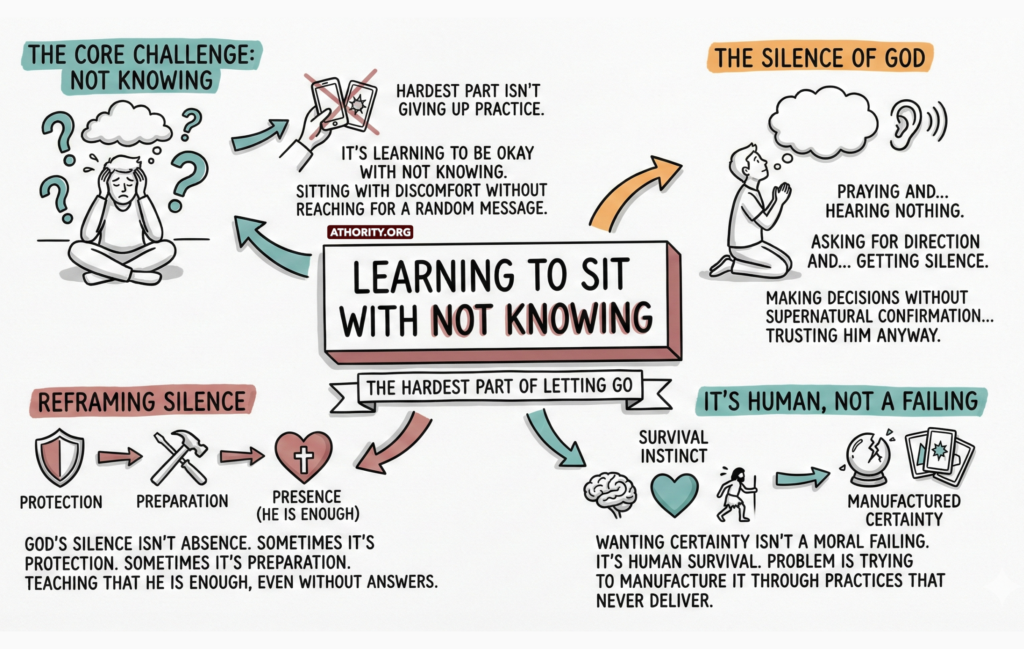
It’s sitting with the discomfort of uncertainty without reaching for a random message to make it stop.
It’s praying and… hearing nothing.
Asking God for direction and… getting silence.
Making a decision without supernatural confirmation and… trusting Him anyway.
I’m learning that God’s silence isn’t absence. Sometimes it’s protection. Sometimes it’s preparation. Sometimes it’s simply Him teaching me that He is enough… even when He doesn’t give me the answers I think I need.
And wanting to know what’s coming next isn’t some moral failing. It’s human. It’s wired into us for survival. The problem isn’t that you want certainty. It’s that you’ve been trying to manufacture it through spiritual practices that can never actually deliver it.
The Question I Don’t Have an Answer To (Yet)
So where does that leave you?
I don’t know what your specific next step is.
I don’t know if you’re supposed to block that TikTok tarot reader tonight or if you need to taper off more gradually. I don’t know if your next move is to find a good therapist who understands both anxiety and spirituality, or to just start reading Psalms when the restlessness hits, or something else entirely.
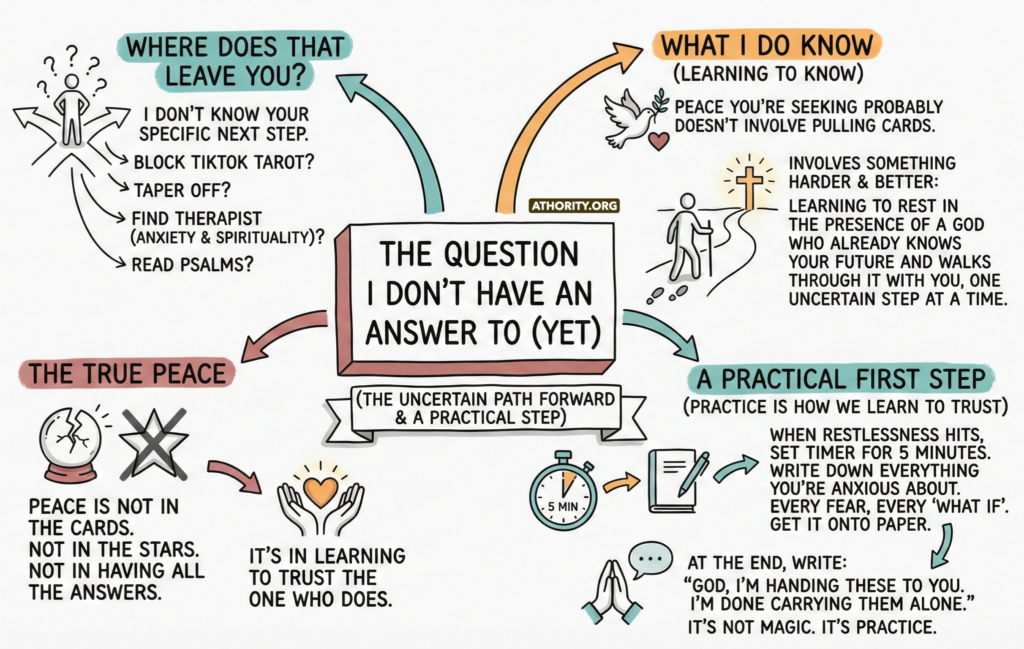
What I do know… or what I’m learning to know, which might be more accurate… is that the peace you’re seeking probably doesn’t involve pulling cards.
It probably involves something much harder and much more uncomfortable and ultimately much better… learning to rest in the presence of a God who already knows your future and loves you enough to walk through it with you, one uncertain step at a time.
The peace you’re actually seeking? It’s not in the cards. It’s not in the stars. It’s not in having all the answers.
It’s in learning to trust the One who does.
If you need help taking a practical first step: If reading the bible feels too still right now, the next time the restlessness hits, and you feel your hands reaching for the cards or the app, set a timer for five minutes. Just five. And in that five minutes, write down everything you’re anxious about. Every fear, every “what if.” Get it out of your head and onto paper. Then, at the end, write: “God, I’m handing these to You. I don’t know what You’ll do with them, but I’m done trying to carry them alone.” It’s not magic. But it’s practice. And practice is how we learn to trust.
And when you’re ready, look up 1 Peter 5:7 (NLT). It’s one verse. Read it slowly. Let it sit with you. And if you don’t have a Bible, you can read it free online at Bible Gateway.