
You’ve seen the moment. Maybe you’ve been in the room when it happened.
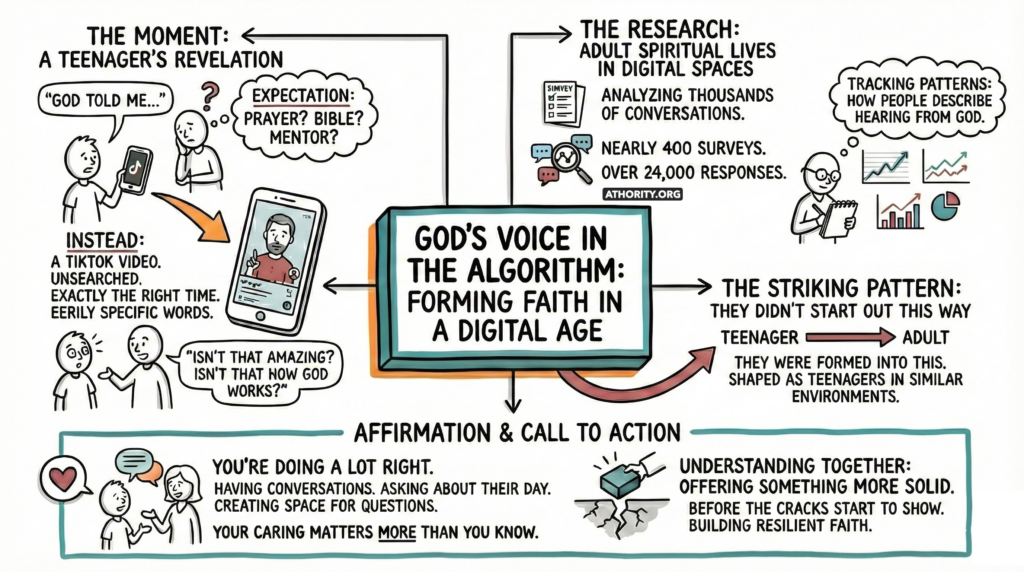
Your teenager says “God told me” and you lean in, expecting something about prayer or the Bible or a conversation with a mentor. Instead, they explain that a TikTok showed up on their feed at exactly the right time. A video they didn’t search for, featuring someone they’ve never met, speaking words that felt eerily specific to their situation.
And they’re looking at you like… isn’t that amazing? Isn’t that how God works?
I spend a lot of time studying how adults build their spiritual lives in digital spaces. I’ve analyzed thousands of conversations across nearly 400 surveys with over 24,000 total responses, tracking patterns in how people describe hearing from God. And what keeps striking me: the adults I study didn’t start out this way. They were formed into this. Many of them were shaped as teenagers, in environments like the one your kids are navigating right now.
And I want to say something before we go any further: if you’re reading this, you’re probably doing a lot right. Having conversations about faith. Asking about their day. Trying to create space for questions. The fact that you care enough to think about what’s shaping your kids spiritually… that matters more than you know.
But I do think there’s something happening that’s worth understanding together, so we can offer young people something more solid before the cracks start to show.
The Training No One Planned
Something took me a while to fully grasp: the algorithm doesn’t choose sides.
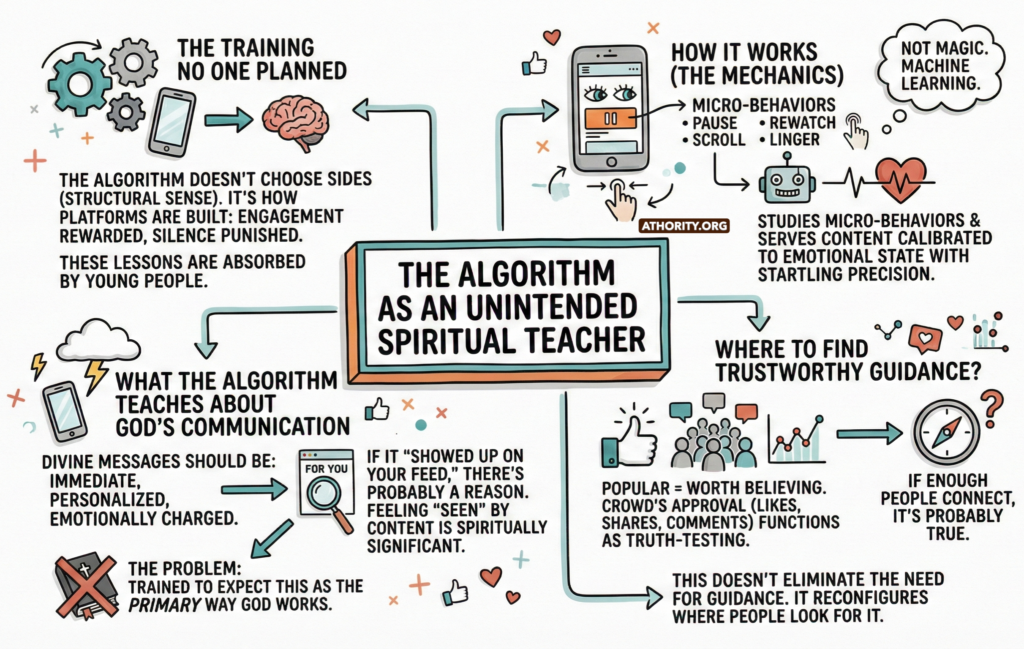
I don’t mean that in the conspiracy sense. I mean it in the structural sense. The way these platforms are built, the way content rises and falls, the way engagement is rewarded and silence is punished… all of it teaches certain things about how truth works. And those lessons are being absorbed by young people who think they’re scrolling for entertainment.
I know how this can sound. Every generation has worried about the technology shaping their kids. But this isn’t about whether screens are bad. It’s about what the structure of these platforms teaches, regardless of the content being consumed.
Let me be clear about what I’m saying. I’m not claiming God can’t use a video your kid stumbles across. He’s sovereign. He’s used stranger things. The question isn’t whether God occasionally works through unexpected means. The question is whether kids are being trained to expect that’s how He primarily works. The algorithm doesn’t distinguish between those two things. It can’t. That’s not what it’s built to do.
(Stay with me on this, because the mechanics matter.)
The teams behind platforms like TikTok and Instagram include psychologists, behavioral scientists, and user interface researchers. Their job isn’t to disciple anyone. It’s to make the platform as captivating as possible. TikTok’s algorithm doesn’t show your kid random videos. It studies their micro-behaviors: what they pause on, what they rewatch, what they scroll past, what they linger over even for a second. Then it serves content calibrated to their emotional state with startling precision.
When someone is spiritually vulnerable and a video appears that speaks directly to their situation… it’s not magic. It’s machine learning. But it feels like something more. And that’s the problem.
What does the algorithm teach about how God communicates? That divine messages should be immediate, personalized, and emotionally charged. That if content “showed up on your feed,” there’s probably a reason. That the feeling of being seen by a piece of content is spiritually significant.
What does it teach about where to find trustworthy guidance? That what’s popular must be worth believing. That the crowd’s approval (likes, shares, comments) functions as a kind of truth-testing. That if enough people connect with something, it’s probably true.
This doesn’t eliminate the need for guidance. It reconfigures where people look for it.
What the Data Shows
The patterns in my research were stark. And, honestly, a little heartbreaking.
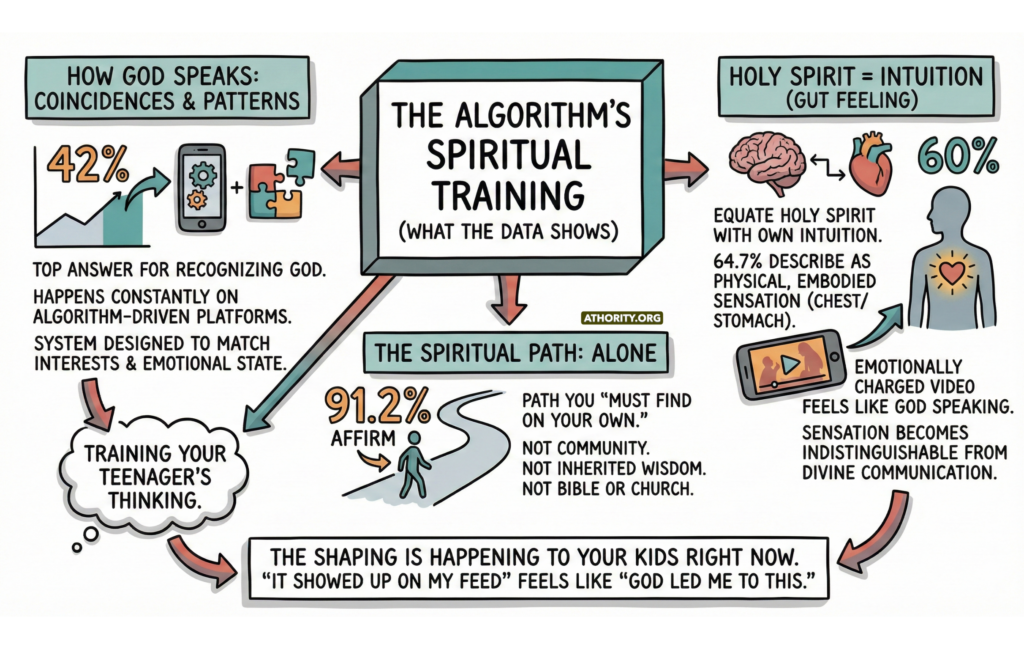
When I asked adults how they recognize a sign from God, the top answer wasn’t the Bible. It wasn’t community. It wasn’t the wisdom of mature believers. Forty-two percent identified “coincidences and patterns” as how God speaks to them. The kind of thing that happens constantly on algorithm-driven platforms, where the whole system is designed to serve you content that matches your interests and emotional state.
Your teenager isn’t there yet. But they’re being trained in exactly the way of thinking that leads there.
Sixty percent of the adults I study directly equate the Holy Spirit with their own intuition. Their “gut feeling” is the Spirit, in their understanding. And when I asked how they define that intuition, 64.7% described it as a physical, embodied sensation… a feeling in their chest or stomach. Which means when an emotionally charged video appears at a vulnerable moment, it doesn’t seem like good timing. It seems like God speaking directly to them. The sensation in their body becomes indistinguishable from divine communication.
When I asked about the spiritual path itself, an overwhelming 91.2% affirmed it’s something you “must find on your own.” Not within community. Not through inherited wisdom. Not by submitting to the teaching of the Bible or the church. Alone. The algorithm didn’t create that belief, but it trains young people in exactly the habits that make that belief feel obvious.
I want you to understand (and I say this gently): these adults didn’t arrive at this understanding through deliberate study or careful instruction. Most of them absorbed it. They were shaped in environments where the algorithm’s patterns became hard to distinguish from spiritual guidance. Where “it showed up on my feed” started to feel the same as “God led me to this.”
And the same shaping is happening to your kids right now.
Where This Road Leads
I’ve spent years listening to adults who were shaped this way. And I want to describe what I see, not to scare you, but because I think it helps to know where the road leads so we can offer something different earlier.
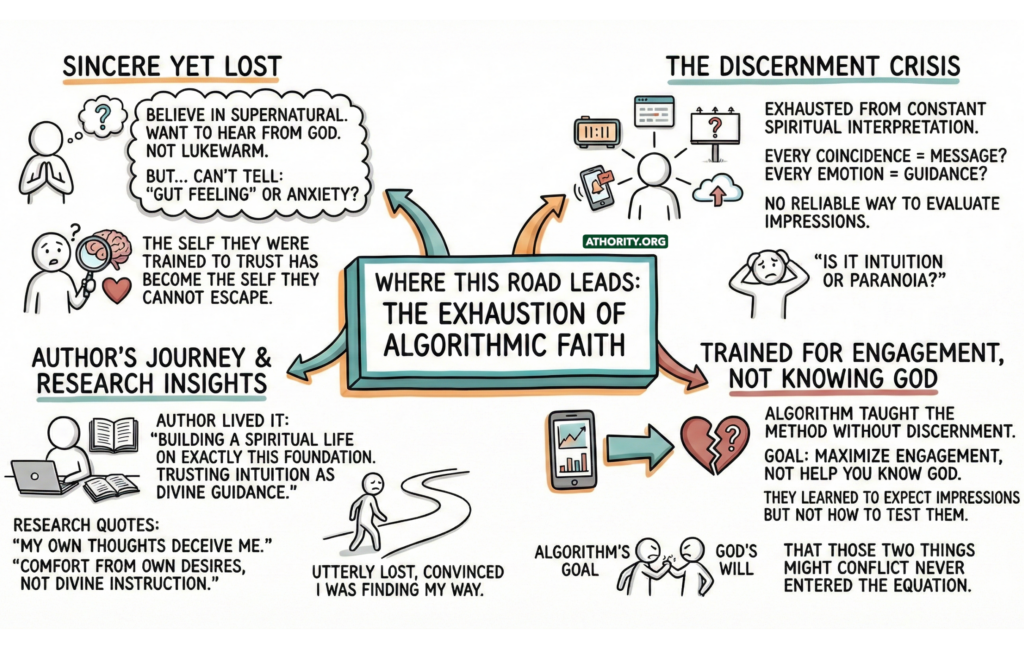
These adults believe in the supernatural. Sincerely. They want to hear from God, they expect the Holy Spirit to move, they take spiritual reality seriously. Nothing about their faith is lukewarm.
But they can’t tell if their “gut feeling” is the Holy Spirit or their own anxiety. They see signs everywhere (numbers, synchronicities, well-timed videos) but can’t figure out which ones are from God and which are pattern recognition. They’re exhausted from constant spiritual interpretation. Every coincidence might be a message. Every gut reaction might be guidance. Every emotionally charged piece of content might be God trying to tell them something.
I know this exhaustion because I lived it. Years ago, before I returned to biblical Christianity, I was building a spiritual life on exactly this foundation. Trusting my intuition as divine guidance. Taking what spoke to me from different sources and assuming that the feeling of connection meant God was in it. I had enough Christian background to sound credible, enough genuine seeking to be convincing. And I was utterly lost, even though I was convinced I was finding my way.
The adults in my research describe it in ways that make my stomach drop because I recognize myself in their words. One person put it this way: “My own thoughts, that are out of my control, deceive me and lead me to sinful actions.” Another concluded that the things that “bring me comfort are my own desires” and not divine instruction. The self they were trained to trust has become the self they cannot escape.
They keep asking, with increasing desperation: “Is it intuition or paranoia?” “How do I know if it’s God or my anxiety?” “I see signs everywhere but I don’t know if they’re from Him.”
These adults have told me things like: “I can’t drive past a billboard without wondering if it’s a message.” “Every time I see 11:11 on a clock, my heart rate spikes.” “I’ve made major life decisions based on Instagram posts and then couldn’t sleep for weeks wondering if I heard God correctly.”
Do you see what’s happened? They’ve been trained to expect God to communicate through internal impressions and external coincidences. But they never developed a reliable way to evaluate those impressions. They learned the method without ever learning discernment, without ever learning how to test whether something is from God.
And how could they? The algorithm wasn’t trying to help them know God. It was trying to maximize their engagement. That those two things might conflict never entered the equation.
What This Means for Those of Us Who Care
I want to land here, and I’m saying this as someone who has spent years in this research and who truly wants to help: you’re not competing with content. You’re competing with a whole way of understanding what’s true.
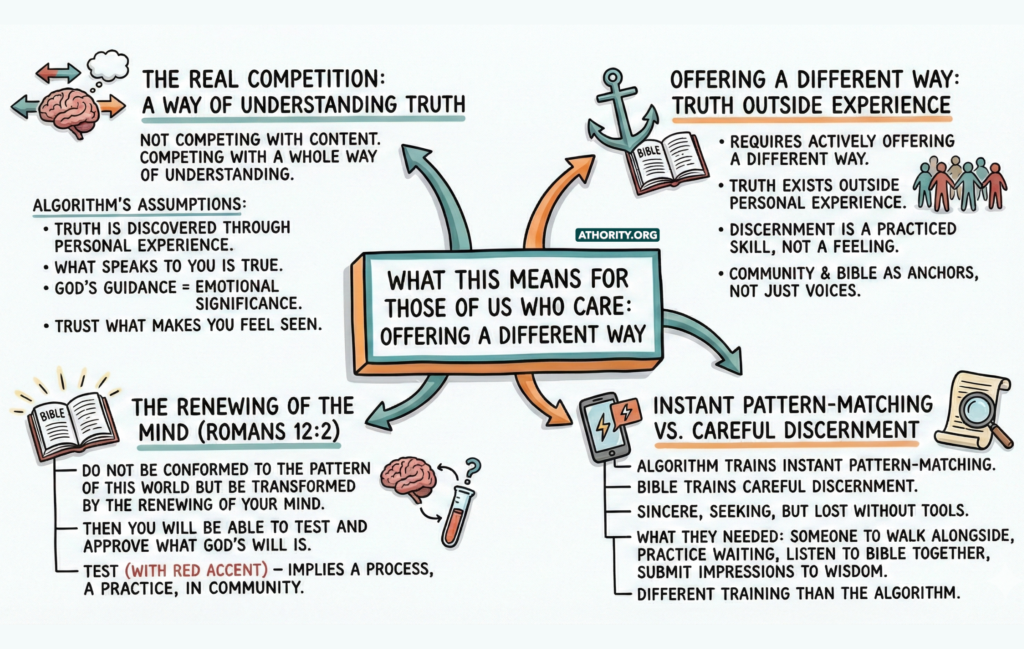
The algorithm has already taught your kids (and many adults in your congregation) certain assumptions about how truth works. Something like: Truth is discovered through personal experience. What speaks to you is what’s true for you. God’s guidance manifests as emotional significance. You can trust whatever makes you feel seen.
This isn’t something you can counter by telling kids to get off social media. (Good luck with that approach anyway.) It requires actively offering a different way. One where truth exists outside personal experience. Where discernment is a practiced skill, not a feeling. Where the community of believers and the testimony of the Bible function as anchors, not one voice among many competing options.
There’s something in Romans about this (I find myself returning to it often) about not being conformed to the pattern of this world but being transformed by the renewing of your mind. “Then you will be able to test and approve what God’s will is” (Romans 12:2, NLT). The word “test” catches me. Not feel. Not intuit. Test. That implies a process, a practice, something that develops over time in community. The algorithm trains instant pattern-matching. The Bible trains careful discernment.
The adults I study are often deeply sincere, seeking hard, and utterly lost. They love Jesus. They want to hear from God. And they don’t have the tools to distinguish His voice from the noise because no one ever walked alongside them and taught them how.
They learned to expect guidance that feels like a personalized notification. What they needed was someone helping them practice waiting, listening to the Bible together, submitting their impressions to the wisdom of people who love them. They needed what Paul describes as the renewing of the mind… and that’s a different kind of training than anything the algorithm provides.
Some Questions Worth Exploring
I’m not going to pretend I have this figured out. I’m still working through what this research means for parenting and ministry. But here are the questions I keep returning to, and maybe they’re worth exploring together:
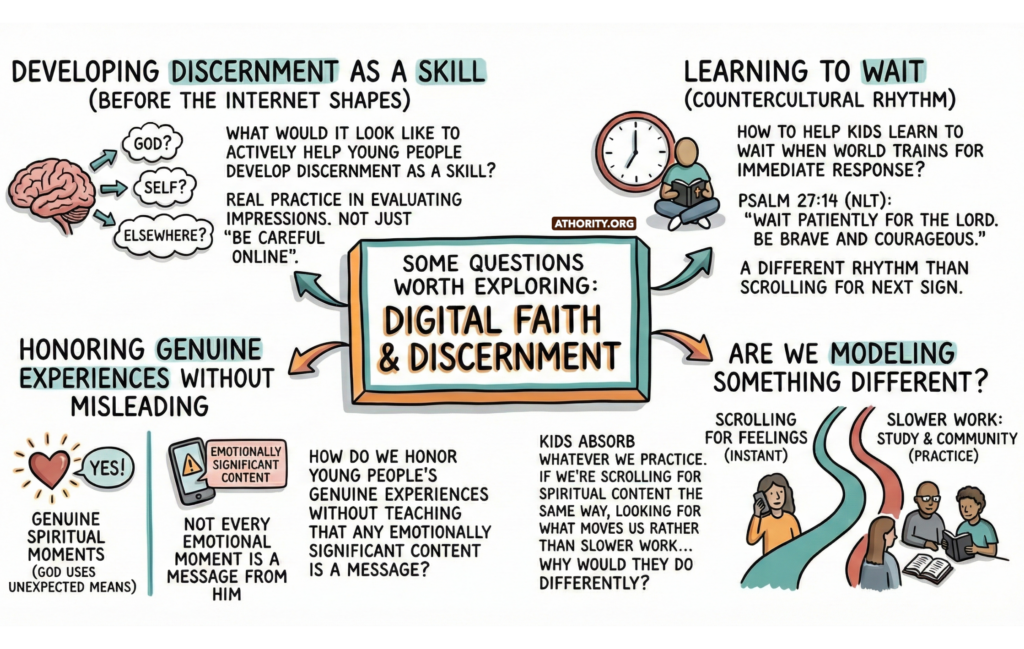
What would it look like to actively help young people develop discernment as a skill, before the internet shapes their assumptions about how to hear from God? Not “be careful online,” but real practice in evaluating whether an impression might be from God, from themselves, or from somewhere else entirely.
What does it look like to help kids learn to wait, when everything in their world trains them for immediate response? There’s something in the Psalms about waiting on the Lord that feels countercultural in ways that might serve us here. “Wait patiently for the Lord. Be brave and courageous. Yes, wait patiently for the Lord” (Psalm 27:14, NLT). That’s a different rhythm than scrolling for the next sign.
How do we honor young people’s genuine spiritual experiences (because God does sometimes use unexpected moments) without accidentally teaching them that any emotionally significant content can be treated as a message from Him?
And maybe most importantly: are we modeling something different? Because kids absorb whatever we practice, regardless of what we say. If we’re scrolling for spiritual content the same way they are, looking for whatever moves us rather than doing the slower work of study and community… why would they do anything different?
One Practice That’s Helped
When someone I’m walking with tells me about something that “showed up on their feed,” I don’t dismiss it. I don’t immediately say “that’s not how God works.” Instead, I ask, “What do you think you’re supposed to do with that?”
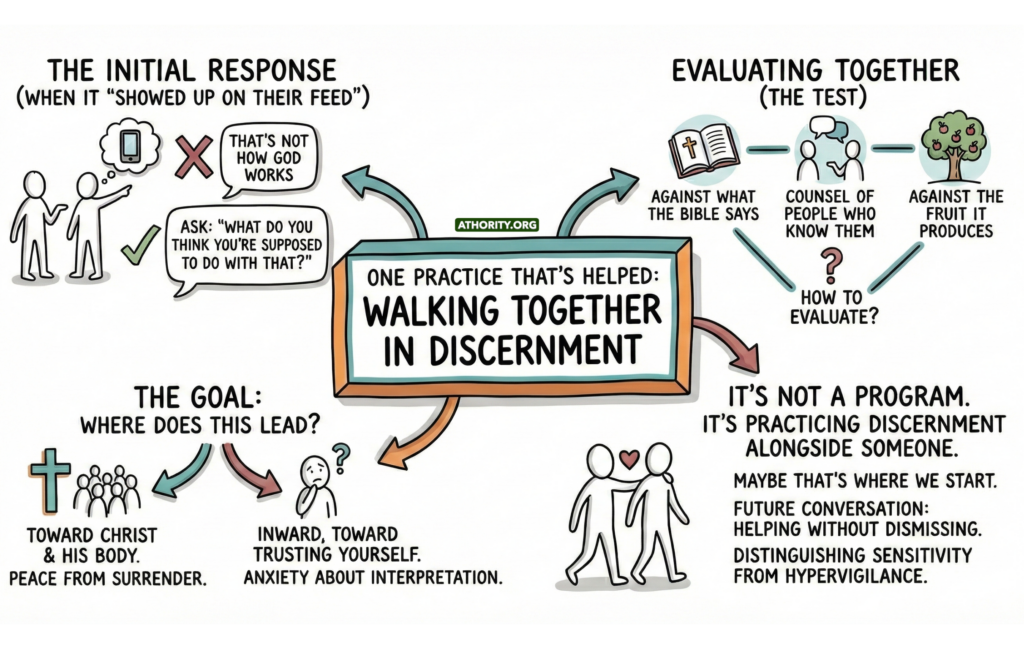
And then we talk through how to evaluate it together. Against what the Bible says. Against the counsel of people who know them. Against the fruit it produces. Does this lead you toward Christ and His body, or does it lead you inward, toward trusting yourself more? Does it create peace that comes from surrender, or anxiety about whether you interpreted the sign correctly?
It’s not a program. It’s practicing discernment alongside someone. Maybe that’s where we start.
There’s a whole other conversation to be had about what this kind of training looks like in practice (how to help someone evaluate an impression without making them feel dismissed, how to distinguish healthy spiritual sensitivity from anxious hypervigilance). But that’s probably a whole other reflection.
The Hope Underneath the Concern
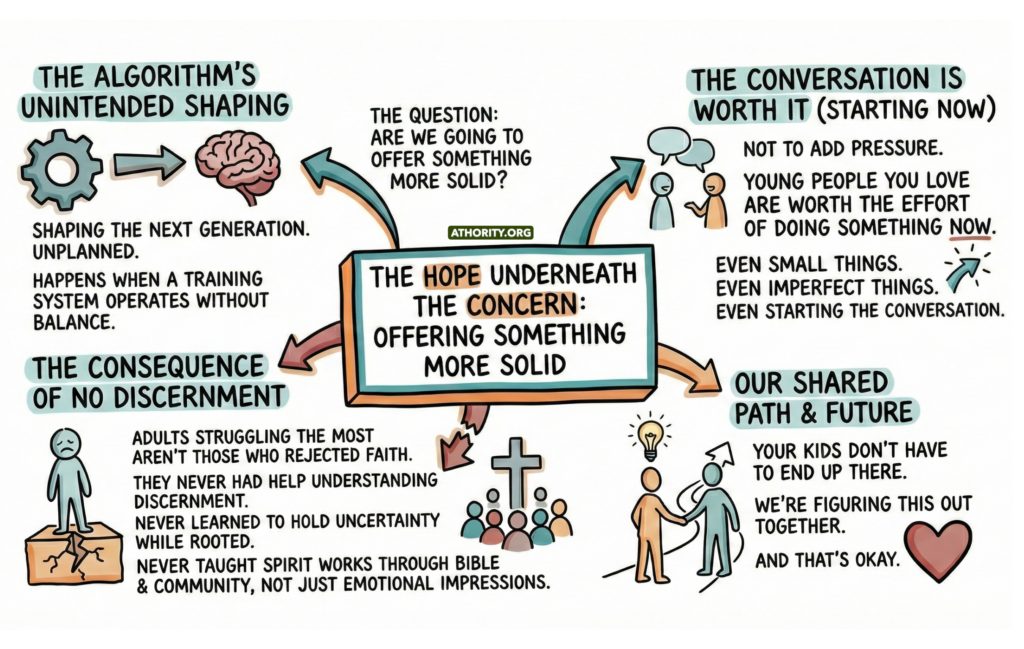
The algorithm is shaping the next generation. Not because anyone planned it that way. Because that’s what happens when a training system operates without anything to balance it. The question is whether we’re going to offer something more solid.
And whether we’re going to offer it before the cracks start to show.
I don’t say that to add pressure. I say it because I’ve seen what happens on the other side, and I think the young people you love are worth the effort of doing something now. Even small things. Even imperfect things. Even starting the conversation.
The adults in my research who are struggling the most aren’t the ones who rejected faith entirely. They’re the ones who never had anyone help them understand what discernment looks like. Who never learned to hold uncertainty while staying rooted in something bigger than their feelings. Who were never taught that the Holy Spirit works through the Bible and community, not through emotional impressions that show up at convenient moments.
Your kids don’t have to end up there.
We’re figuring this out together. And that’s okay.