You meant it with everything you had.
“Trust God.” Two words. Sincere. Offered like a lifeline because that’s exactly what it’s been for you. It got you through a season that nearly broke you. It’s the truest thing you know how to say when someone you love is struggling.
And somehow, it landed like an accusation.
Their eyes glazed over. Or they nodded and changed the subject. Or (and this is the one that keeps you up) they got defensive. As if you’d insulted them instead of offering the most precious thing you have.
I’m not here to tell you that you said the wrong thing. You didn’t. “Trust God” is biblical. It’s foundational. It’s the bedrock of everything you believe about how faith works.
But I am here to tell you that something is getting lost in translation. And it’s not a small thing.
The Shift You Didn’t See Happening
Whether you’re a parent, a youth pastor, a small group leader, or the person a young believer trusts enough to be honest with… there’s a fundamental change happening in how an entire generation understands truth, guidance, and spiritual authority.
This is what it looks like.
For most of Christian history (and probably for most of your own formation), truth and authority worked like this: external sources inform internal experience. Scripture, doctrine, wise teachers, the church. These external anchors shaped how you understood your inner life. Your feelings and intuitions were real, but they were filtered through a framework that existed outside of you.
For the young person in front of you, this is likely reversed.
The dominant model now positions the self as the ultimate judge of spiritual truth. Internal experience (what “resonates,” what feels authentic, what their gut tells them) has become the filter through which all external sources are evaluated. Including Scripture. Including you.
I know this because I lived it. For years, I was convinced that trusting my intuition was the same as trusting God. My Christian upbringing gave me enough spiritual vocabulary to sound credible, enough awareness of the sacred to believe I was drawing closer to Him. But somewhere along the way, I’d made my inner experience the final authority on everything. Even Scripture. I took what “resonated” and quietly set aside what didn’t.
I didn’t think I was drifting. I thought I was evolving.
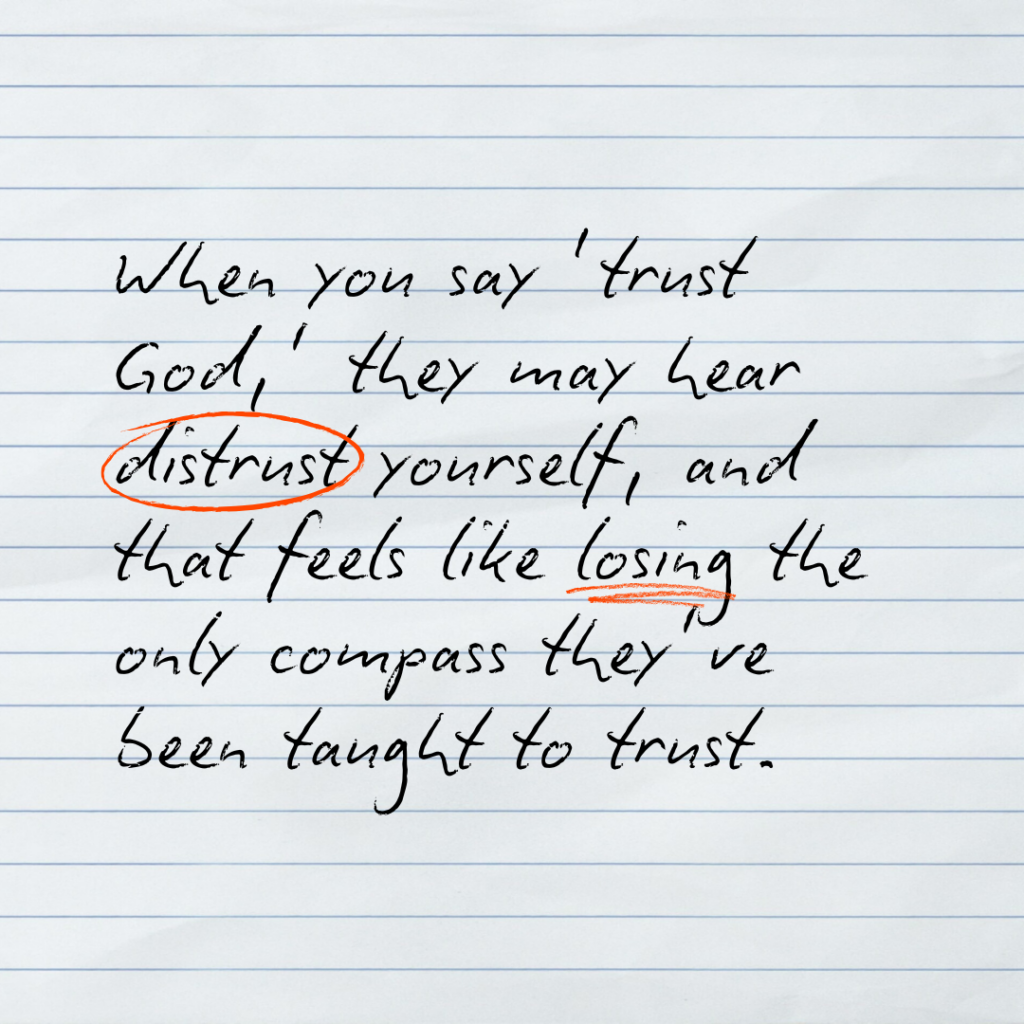
When you say “trust God,” the young person you love may be hearing: “Distrust yourself.”
And if they’ve absorbed the message that their inner compass is the most reliable guide they have… that’s not an invitation. It’s a demand to abandon their primary navigation system in favor of external control.
When the Holy Spirit Became a Gut Feeling
This part genuinely surprised me when I started researching how spiritually-active young people think about these things.
Over half of them have redefined the Holy Spirit. Not rejected Him. Redefined Him. For them, the Holy Spirit isn’t a divine Person who speaks into their lives from outside themselves. The Holy Spirit is their intuition. Their gut feeling. That inner knowing they experience when something “resonates.”
So when you tell your teen to “let the Holy Spirit guide you,” you might be thinking: surrender to God’s Spirit who knows infinitely more than you do and can direct your steps.
They might be hearing: trust your gut. Which is exactly what they were already doing.
The guidance has been relocated. From “out there” to “in here.” From a Person who speaks to a feeling that confirms. And once that conceptual move happens, the entire framework of Christian trust starts sounding like it’s about something else entirely.
This isn’t rebellion. It’s not laziness. It’s a fundamental change in how they understand where truth comes from. And most of them didn’t consciously choose it. They absorbed it. From TikTok algorithms. From the therapeutic language that saturates everything. From peers who told them their feelings were always valid. From a culture that treats “what resonates” as the highest form of discernment.
The young person you’re trying to reach isn’t rejecting spiritual guidance. They’ve been taught that all legitimate guidance originates inside themselves.
The Crisis Nobody Warned Them About
And here’s where it gets painful.
Because what sounds like freedom (“you’re your own spiritual authority”) eventually collapses under its own weight.
I watched it happen in my own life. I’ve watched it happen in friends, in research subjects, in hundreds of online conversations. The pattern is consistent.
The promise of self-directed spirituality is deeply appealing. You get to decide what’s true for you. You’re not bound by anyone else’s interpretation of Scripture or anyone else’s rules about what practices are acceptable. You’re in charge.
But I didn’t understand until I was drowning in it: being your own ultimate spiritual authority is exhausting.
When you’re the sole arbiter of truth, every decision carries infinite weight. When your intuition is your only compass, and your intuition is compromised by anxiety (or trauma, or fear, or the aftermath of that thing you never processed)… you have no external reference point. No stable ground. Nothing to appeal to when your inner world is chaos.
The pursuit of total control leads to burnout. The burden of being your own god buckles the soul.
They start with “I can trust myself to figure this out.” They end with “I can’t trust any of my thoughts and I don’t know which voice inside me is telling the truth.”
The young person you’re worried about might still be in the “freedom” phase. But the crisis is coming. And when it does, you want to be the person they trust enough to call.
What They Hear When Asking Feels Dangerous
There’s another layer here. And it’s one we in the church need to at least consider.
This isn’t true of every church, of course. Your youth group might be a place where hard questions are welcomed. Maybe you’ve just worked hard to create that space. If so, that’s genuinely beautiful, and the young people in your care are blessed. You might have worked hard to create space for doubt and curiosity. If so, that’s genuinely beautiful, and the young people in your care are blessed.
But it’s common enough that we need to name it: a significant percentage of young Christians report feeling unable to ask their most pressing questions in church settings. They’ve learned (whether through explicit messages or subtle cues) that doubt is dangerous, questions are suspect, and intellectual honesty might get them labeled as “struggling” or “lukewarm.”
When that’s the background noise… “trust God” doesn’t land as an invitation to deeper relationship.
It lands as: “Stop asking questions.”
Or: “Your doubts are the problem.”
Or even: “The institution that already made you feel unsafe for thinking critically wants you to surrender your judgment entirely.”
And I have to ask us an uncomfortable question: How many churches (not yours, necessarily, but enough) have made questioning feel dangerous? Not heretical questions. Just honest ones. “Why do we believe this?” “How do we know?” “What about the parts of the Bible that feel harsh?”
If the unspoken message anywhere is “good Christians don’t ask those questions,” we’ve inadvertently trained a generation to seek answers elsewhere. The algorithm doesn’t shame them for being curious. It feeds them content. And if we’re not the ones helping them think critically about their faith, someone else will be.
Your church might be different. You might have created space for questions and your teen still drifted. That happens too. The algorithm is relentless, and even the best environments can’t fully compete with 24/7 content designed to capture attention. This isn’t about blaming you. It’s about understanding what they’re swimming in.
The Anxiety Trap Nobody Talks About
Here’s where it gets even more complicated.
Many of the teens you’re trying to reach are genuinely anxious. And they’ve been told, often by well-meaning spiritual voices: trust your intuition. Listen to your inner knowing. Your gut feeling is divine guidance.
But anxiety feels like intuition. Fear feels like knowing. Trauma responses feel like spiritual discernment.
They can’t tell the difference.
So when you say “trust God,” the teen who’s been taught that their gut feeling is the Holy Spirit now has a paralyzing problem: Which feeling do I trust? The anxiety telling me to panic, or the “peace” I’m supposed to find in surrendering? How do I know if this internal sense is divine guidance or my past wounds lying to me again?
They want to trust. Many of them want to surrender and find the peace you’re describing. But they’ve been given a worldview where all the guidance is supposed to come from inside themselves. And their insides are a mess.
“Have faith” without practical tools for distinguishing anxiety from spiritual direction isn’t helpful. It’s asking someone who’s drowning to swim, when the real problem is they were never taught the difference between flailing and actual strokes.
What They’re Running From
When teens drift toward something that feels “more spiritual” than church, they’re not usually running from God.
They’re running from what they’ve been taught God represents: external authority that demands internal suppression. Rules without relationship. Being told what to think instead of being invited to discover. A model that feels like kindergarten when they’re ready for something more.
(That language, by the way: “religion is kindergarten, spirituality is graduation.” It’s everywhere in digital spiritual spaces. Your teen has almost certainly encountered it.)
What’s fascinating is that underneath the rejection, there’s genuine spiritual hunger. They want transcendence. They want guidance. They want something that helps them navigate the chaos of their internal world.
They’ve been taught to seek all of that through self-directed means. And the self, it turns out, buckles under the weight of being its own god. That’s the crisis your teen may already be experiencing… the paralysis that comes from making themselves responsible for distinguishing truth from deception, divine guidance from personal bias, genuine peace from wishful thinking.
They’re exhausted by a burden they were never meant to carry.
What Bridges the Gap
I don’t have a formula. (Anyone who does is selling something.) But I’ve learned a few things about building bridges instead of walls.
Understand that their spiritual hunger is real and legitimate. They’re not rejecting transcendence. They’re seeking it through a different map. The craving for authenticity, for direct experience, for a God who doesn’t require self-suppression: these are longings that orthodox Christianity satisfies. Better, in fact, than the alternatives. But they don’t know that yet. And they won’t hear it from someone who dismisses what they’re seeking.
Use their language before you use yours. Instead of starting with “the Bible says,” try: “What resonates with you when you think about that?” Let them answer before offering Scripture. Instead of “trust God,” try: “I know this feels impossible to navigate. Can I share something that helped me when I felt completely out of control?” Instead of “let the Holy Spirit guide you,” try: “You know that sense you get when something feels deeply right, not comfortable, but right? I think that’s worth paying attention to.”
These aren’t scripts. They’re translations. Bridges that start where they are.
Let them see you wrestle. The young people I’ve encountered aren’t looking for someone who has it all figured out. They’re looking for authenticity. Your honest “I’m still learning too” might be more compelling than your confident pronouncements.
Give them a way to test instead of demanding they trust. There’s a verse in 1 John that I return to often: “Dear friends, do not believe everyone who claims to speak by the Spirit. You must test them to see if the spirit they have comes from God” (1 John 4:1, NLT).
Notice it doesn’t say “distrust your experience.” It says test it. There’s a path for discernment here that doesn’t require abandoning internal experience. It requires evaluating it against something more stable than shifting feelings.
You could say: “You don’t have to stop trusting your gut. But what if we talked about how to test what your gut is telling you?”
That’s not shutting them down. That’s inviting them into a more rigorous discernment process… one that honors their experience while offering them an anchor outside themselves.
The Question I Can’t Stop Asking
The real work might not be teaching our kids to trust God more.
Maybe it’s examining whether we’ve accidentally communicated that God is Someone who needs to be trusted against themselves… rather than Someone who made their selves and knows how to heal them.
There’s something Paul writes about being transformed by the renewing of your mind (Romans 12:2, NLT). It’s interesting because it validates transformation happening internally, but it redirects the source of that transformation from self to God. That’s the bridge. Not “suppress yourself and obey” but “let Something greater than yourself do the renewing.”
Jesus didn’t say “get them to comply.” He said teach them to observe everything I commanded, and “I am with you always” (Matthew 28:20, NLT).
With you. Not over you. Not demanding your suppression. Present.
What if “trust God” isn’t about self-abandonment at all? What if it’s about finally letting Someone who knows what He’s doing take over the impossible task of being your own ultimate authority?
Your teen might be ready to hear that.
They need you to say it in a language they can receive.
Where to Start
This week, try asking one question. Not “why don’t you trust God?” Not “what’s wrong with your faith?”
This: “What would have to be true for you to feel like you could trust God?”
Then listen. Don’t correct. Don’t defend. Just listen.
Their answer will tell you exactly where to start.
You don’t have to have all the answers. You don’t have to fix their whole worldview in one conversation. You have to be safe enough to hear what’s going on… and curious enough to meet them there.
And if you want to go deeper on understanding the digital spiritual landscape your kids are navigating, there’s so much more we could explore about what Paul means by “the mind of Christ” and how that reframes everything about discernment.
But for now, start with the question. See what opens.