You’ve been praying for the same thing for years now.
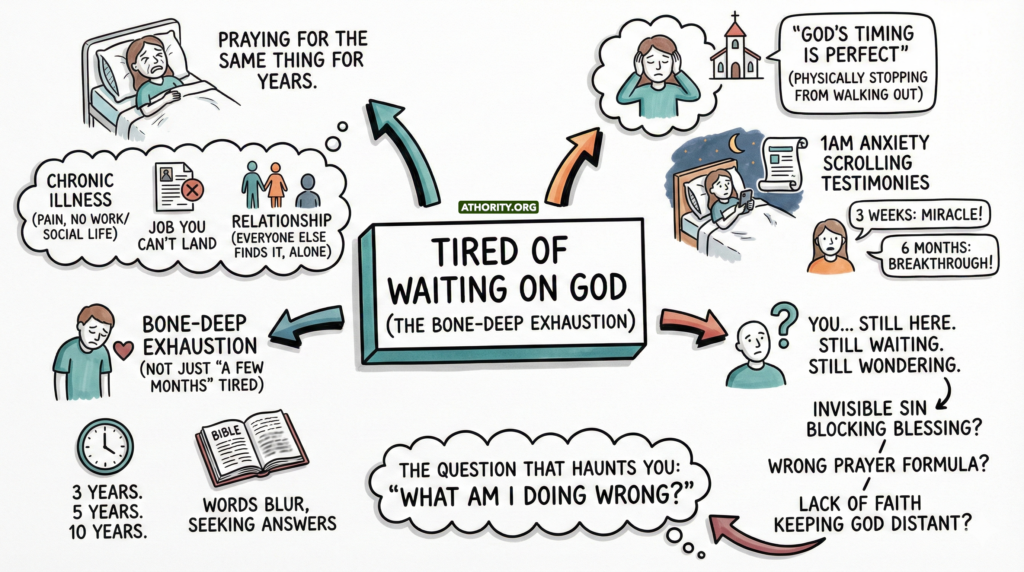
Maybe it’s healing from the chronic illness that’s stolen your ability to work, to socialize, to just… exist without pain. Maybe it’s the job you can’t seem to land no matter how qualified you are. Maybe it’s the relationship that everyone else seems to find effortlessly while you’re still alone, wondering if God even remembers you asked.
And you’re tired of waiting on God.
I’m not talking about the “it’s been a few months” kind of tired. I’m talking about the bone-deep exhaustion that comes from praying the same prayer for three years. Five years. Ten years. The kind of tired where you open your Bible and the words blur because you’ve read them so many times looking for answers that haven’t come. The kind of tired where someone at church says “God’s timing is perfect” and you have to physically stop yourself from walking out.
You scroll through testimonies at 1am when the anxiety won’t let you sleep. Three weeks, they got their miracle. Six months, they got their breakthrough. And you… you’re still here. Still waiting. Still wondering what invisible sin is blocking your blessing, what prayer formula you’re getting wrong, what lack of faith is keeping God at a comfortable distance.
And the question that haunts you: “What am I doing wrong?”
When God’s Presence Looked Like Rejection
I need to be honest with you about something from my own journey, because I know what that question feels like from the inside.
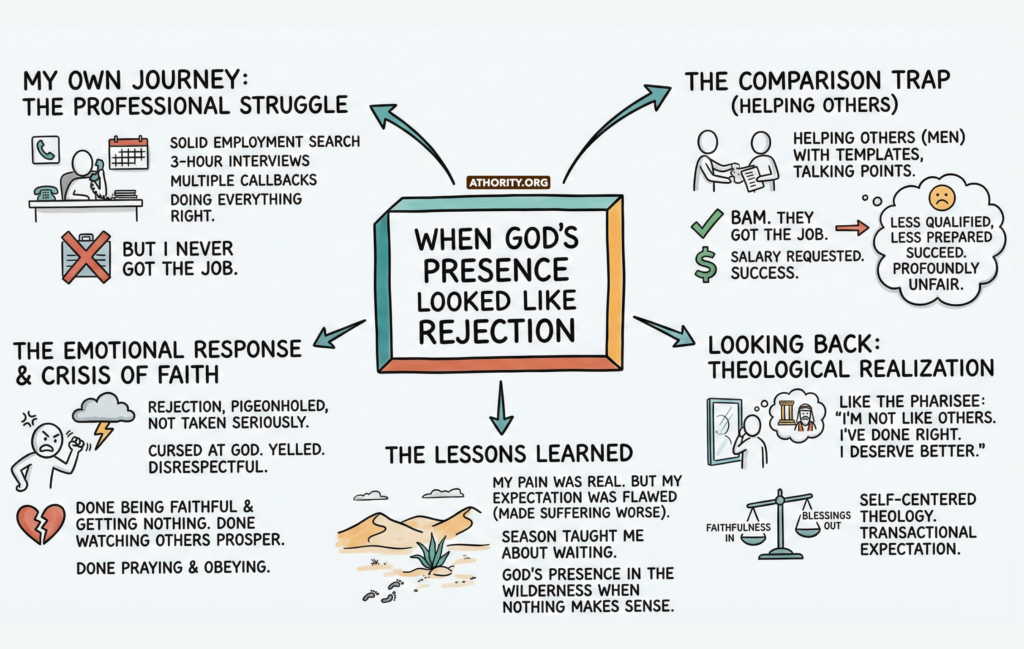
I was looking for solid employment. Going through three-hour interviews, getting multiple callbacks, doing everything right. But I never got the job.
Meanwhile, I was helping others (generally men) who would use the portfolio templates I created, the talking points I provided, and after their first interview… bam. They got the job. With the salary they requested. No one trying to undercut them. No endless rounds of interviews. Just success.
I watched people I felt were less qualified, less prepared, less deserving than me succeed while I kept getting passed over. It felt profoundly unfair. I had done everything right. I had the foundation, the skills, the work ethic. I was helping others succeed. But God wasn’t doing for me what He was doing for them.
That rejection, that pattern of being overlooked and pigeonholed and not taken seriously, did something to me. I cursed at God. I yelled at Him. I was disrespectful in ways I’m not proud of now. I told Him exactly what I thought about how He was handling my life. I was done. Done being faithful and getting nothing in return. Done watching others prosper while I struggled. Done praying and obeying and still being overlooked.
Looking back now, I can see what I couldn’t see then. I was like the Pharisee in Jesus’ parable, standing before God and essentially saying, “I’m not like those other people. I’ve done everything right. I deserve better.” My theology was self-centered. I expected God to operate like a transaction… faithfulness in, blessings out.
My pain was real. My exhaustion was real. But my expectation of how God should work was deeply flawed. And that flawed expectation was making my suffering worse.
But that season taught me about waiting. And about God’s presence in the wilderness when nothing makes sense.
Twenty-Two Years Of “God Is With You”
You probably know Joseph’s story. Sunday school flannel boards, maybe a musical or two. But here’s what we don’t talk about enough: the timeline.
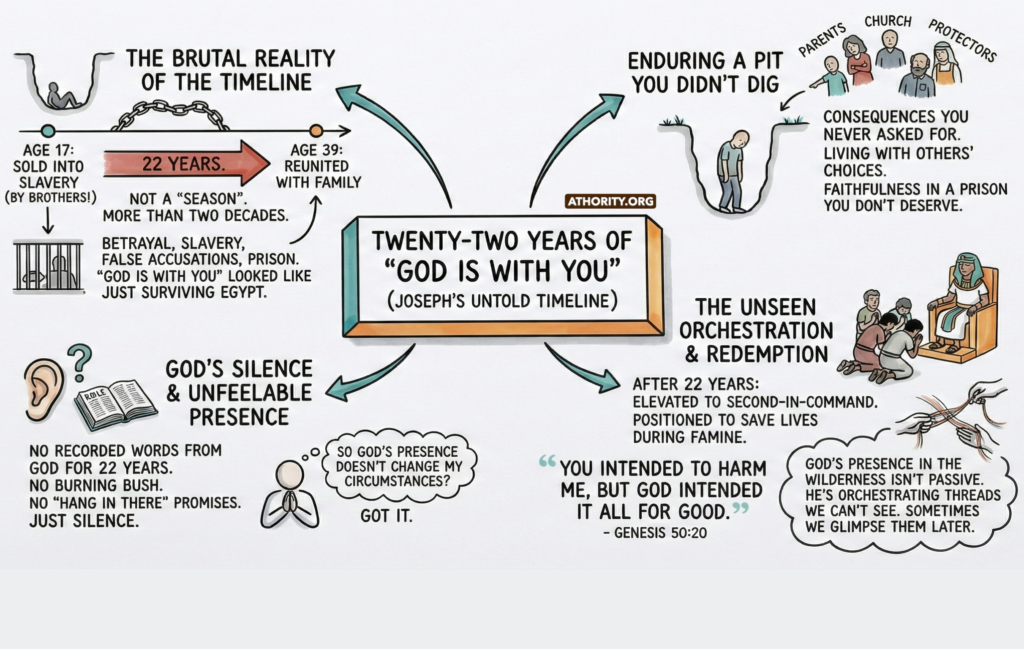
My devotional reading that sparked this reflection focused on Genesis 48:21, where Jacob tells Joseph, “God will be with you and will take you back to Canaan, the land of your ancestors” (Genesis 48:21, NLT). Beautiful, right?
Except Jacob says this while dying. And Joseph has spent twenty-two years navigating betrayal, slavery, false accusations, and prison.
Twenty-two years.
Let that sink in. Joseph’s brothers literally threw him in a pit and sold him into slavery when he was seventeen. Think about that. Not “it was a difficult season.” Not “he experienced some setbacks.” His own family, the people who should have protected him, tried to kill him and then sold him. And he didn’t see them again until he was thirty-nine. That’s not a season. That’s not a wilderness period.
That’s more than two decades of “God is with you” looking a lot less like deliverance and a lot more like just… surviving Egypt.
Maybe your pit wasn’t even dug by your own choices. Maybe it was dug by people who should have protected you, and now you’re living with consequences you never asked for. Maybe you look at where you are and think: if my parents had planned better, if my church had taught me differently, if the people who were supposed to care for me had actually done their job… maybe I wouldn’t be struggling so much now.
I hear you. Sometimes faithfulness means enduring a pit you didn’t dig, a prison you don’t deserve, during a famine you can’t control.
The timeline of Joseph’s story is brutal if you really sit with it. He rises to a position of trust in Potiphar’s house only to be falsely accused of sexual assault and thrown in prison. He interprets dreams that come true, gets someone freed from prison who promises to remember him, and then… gets forgotten for two more years.
Two. More. Years. While he’s already been unjustly imprisoned.
And through all of this, we’re told “the LORD was with Joseph.”
Here’s what strikes me about that phrase: Scripture doesn’t record a single word God spoke to Joseph during those years. No burning bush. No ladder to heaven like his grandfather had. No promises, no explanations, no “hang in there, the breakthrough is coming.” Just silence. And presence that Joseph couldn’t feel.
If you’re anything like me (if you’ve been praying for healing, or waiting for the job, or begging God for clarity for longer than you want to admit), you’ve read that passage and thought… cool. So God’s presence doesn’t actually change my circumstances. Got it.
But here’s what happened after those twenty-two years: Joseph didn’t just get released from prison. He was elevated to second-in-command of Egypt. The very brothers who threw him in the pit came to him for help during the famine, and he was in the exact position to save them.
When Joseph finally revealed himself to his brothers, he said, “You intended to harm me, but God intended it all for good. He brought me to this position so I could save the lives of many people” (Genesis 50:20, NLT).
I’m not saying your suffering will make sense like Joseph’s did. I’m not promising you’ll get a “and it was all worth it!” testimony. Sometimes the purpose stays hidden this side of eternity. But Joseph’s story shows us that God’s presence in the wilderness isn’t passive. He’s orchestrating things we can’t see. And sometimes, sometimes, we get to look back and glimpse the threads He was weaving all along.
The Theology No One Wants To Hear
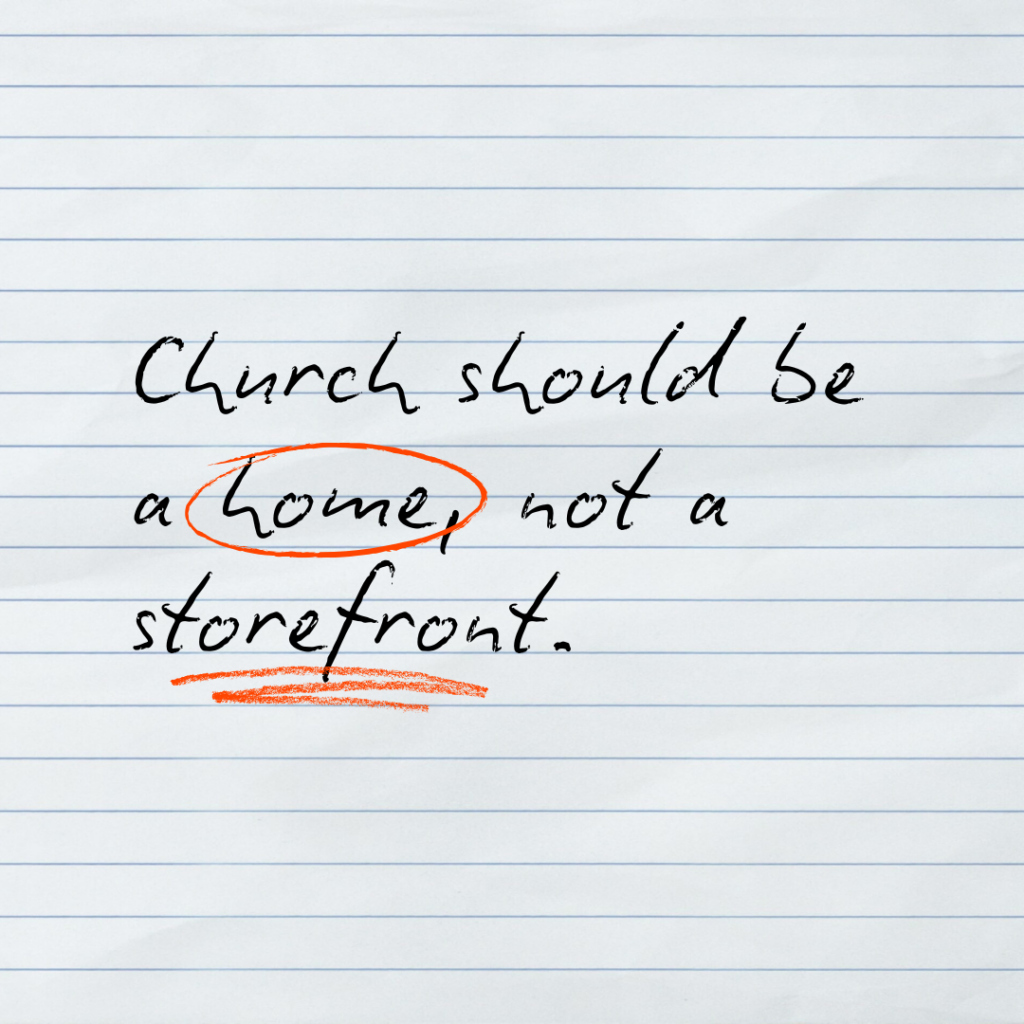
Here’s what we don’t talk about enough in church: God’s presence doesn’t guarantee rescue.
Sometimes it just looks like endurance.
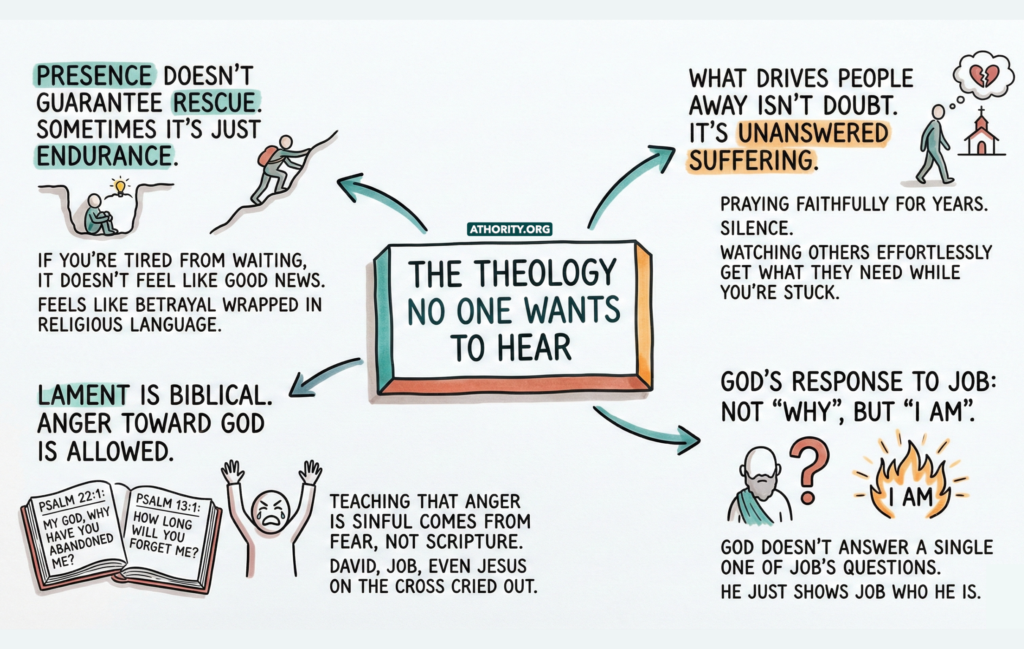
And if you’re tired (really, bone-deep exhausted from waiting), that doesn’t feel like good news. It feels like a betrayal wrapped in religious language.
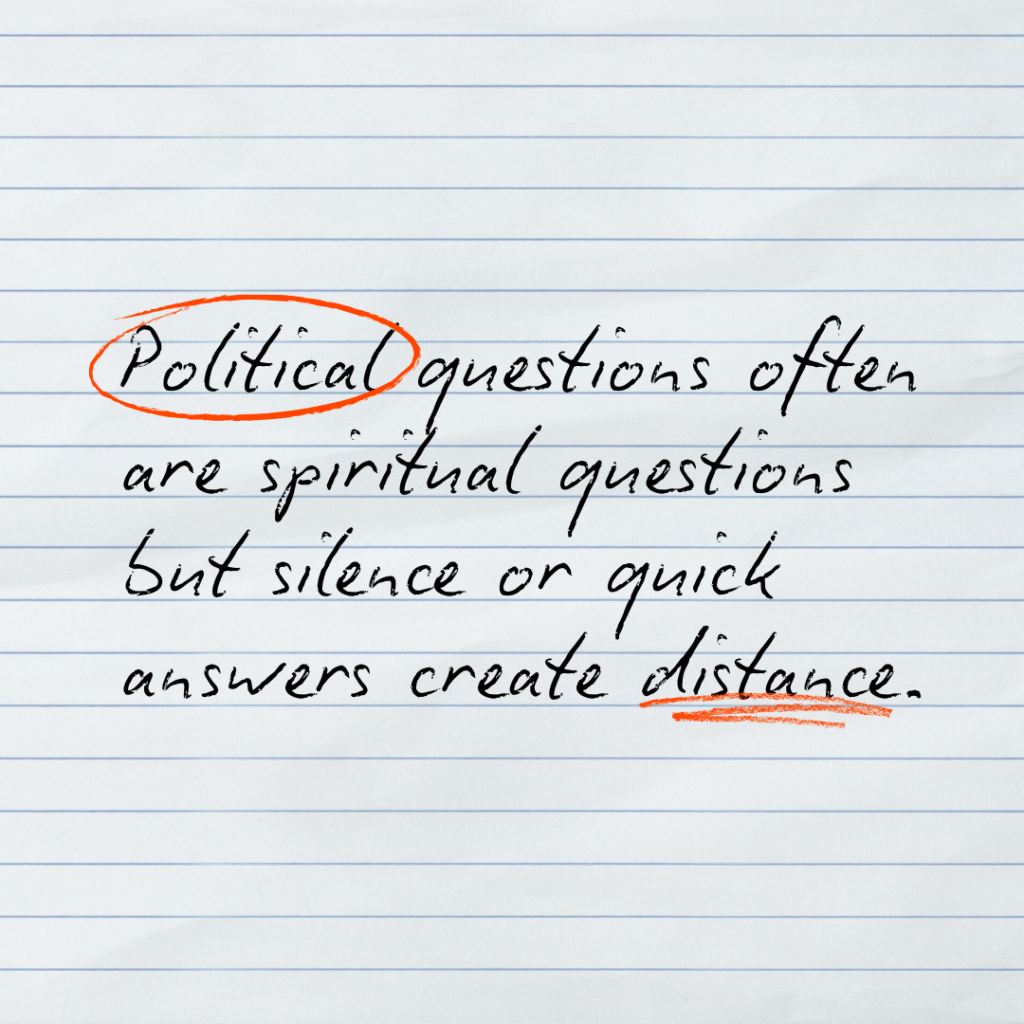
The thing that drives people away from Christianity isn’t usually intellectual doubt. It’s unanswered suffering. It’s praying faithfully for years and hearing nothing but silence. It’s watching others get what they need effortlessly while you’re still stuck in the same pit, wondering what you did wrong to deserve this.
And then some well-meaning Christian tells you it’s all part of God’s perfect timing, and you want to scream.
Scripture puts it differently, though. The Psalms don’t say “God’s timing is perfect.” They say things like: “My God, my God, why have you abandoned me? Why are you so far away when I groan for help?” (Psalm 22:1, NLT). They say: “O LORD, how long will you forget me? Forever? How long will you look the other way?” (Psalm 13:1, NLT).
That’s lament. And it’s just as biblical as praise.
If you grew up being told that anger toward God is sinful, that questioning Him is disrespect, that you should only ever speak good things about Him… I need you to know: that teaching comes from fear, not Scripture. It’s a protective theology, not a biblical one. And I know it feels like I’m asking you to take a risk by saying that. But the Bible gives you permission to be angry. To question. To feel forgotten. David did. Job did. Even Jesus, hanging on the cross, cried out asking why God had forsaken Him. If Jesus Himself felt abandoned in His suffering, why do we think we’re not allowed to?
(There’s a whole section in Job, chapters 38 through 41, where God finally responds to Job’s complaints. And honestly? He doesn’t answer a single one of Job’s questions. He just shows Job who He is. I keep coming back to that. What does it mean that God’s answer to “why?” is simply “I AM”?)
The Lie That Makes It Worse
I need to name something specific here, because I’ve heard it too many times and I know it’s been said to you.
“There must be hidden sin blocking your blessing.”
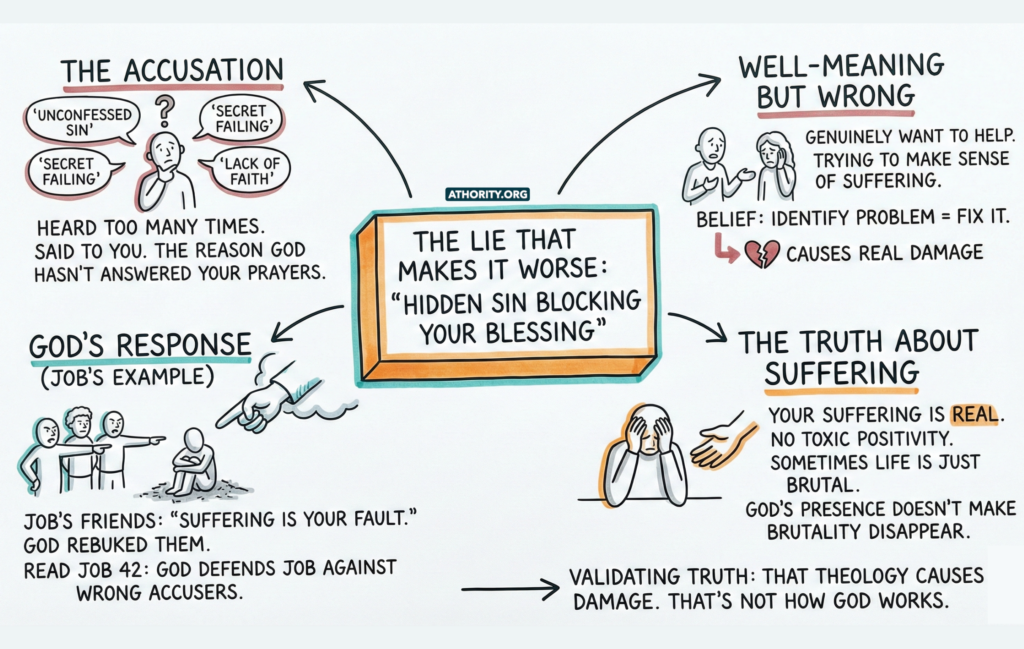
If you’ve been told that the reason God hasn’t answered your prayers is because of some unconfessed sin, some secret failing, some lack of faith you haven’t addressed… I’m so sorry. I know those words often come from people who genuinely want to help, who are trying to make sense of your suffering, who believe that if they can identify the problem, you can fix it.
But that’s not how God works. And that theology causes real damage.
Your suffering is real, and I’m not going to minimize it with toxic positivity or tell you there’s hidden sin blocking your blessing. Sometimes life is just brutal, and God’s presence doesn’t make the brutality disappear. Job’s friends spent chapters trying to convince him that his suffering was his fault, that he must have done something wrong. And God Himself rebuked them for it. Read Job 42 when you get a chance… there’s something deeply validating about watching God defend Job against his well-meaning but wrong accusers.
What The Wilderness Actually Teaches Us
I want to be really careful here, because I know how easy it is to spiritualize suffering in ways that gaslight people’s real pain.
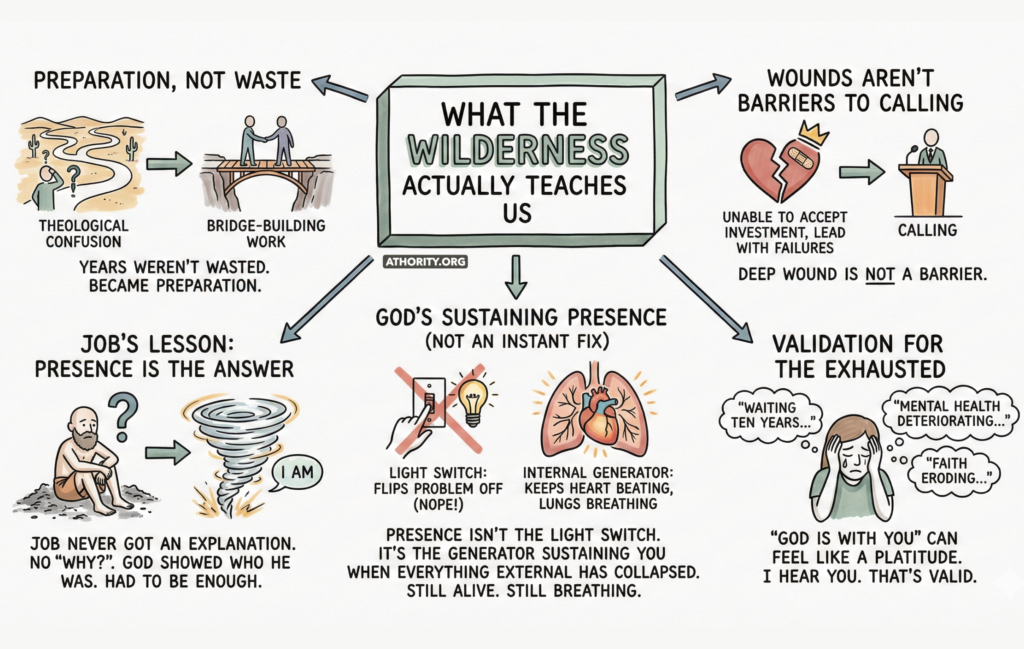
The years I spent in theological confusion weren’t wasted. They became preparation for the bridge-building work I’m doing now. The deep wound I carry (the inability to accept that I’m worthy of investment, the tendency to lead with my failures rather than my redemption) isn’t a barrier to calling.
God has given me far more than I deserve: forgiveness, a church community that invests in me rather than judges me, gifting I didn’t earn, and calling I never sought. His presence has been with me every step, even when I didn’t recognize it.
I need you to hear this, especially if you’re tired: God’s presence in your wilderness doesn’t mean you did something right.
And it doesn’t mean your breakthrough is coming tomorrow.
Think of it like this: God’s sustaining presence isn’t the light switch that flips your problem off. It’s the internal generator that keeps your heart beating and your lungs breathing when everything external has collapsed. You might not see the lights come back on. But you’re still alive. Still here. Still able to take the next breath. That’s God holding you up when you have nothing left.
Job never got an explanation for his suffering. Not really. God showed up, but He didn’t answer the question “why?” He just showed Job who He was. And somehow, that had to be enough.
Maybe you’re reading this and thinking, “Nice story, but I’ve been waiting ten years and nothing has changed. My mental health is deteriorating. My faith is eroding. And ‘God is with you’ feels like a platitude from someone who doesn’t understand what it’s like to pray until your throat is raw and hear nothing back.”
I hear you. That’s valid.
The Difference Between Abandonment And Hiddenness
But I’m slowly learning that there’s a difference between God abandoning you and God being hidden from you.
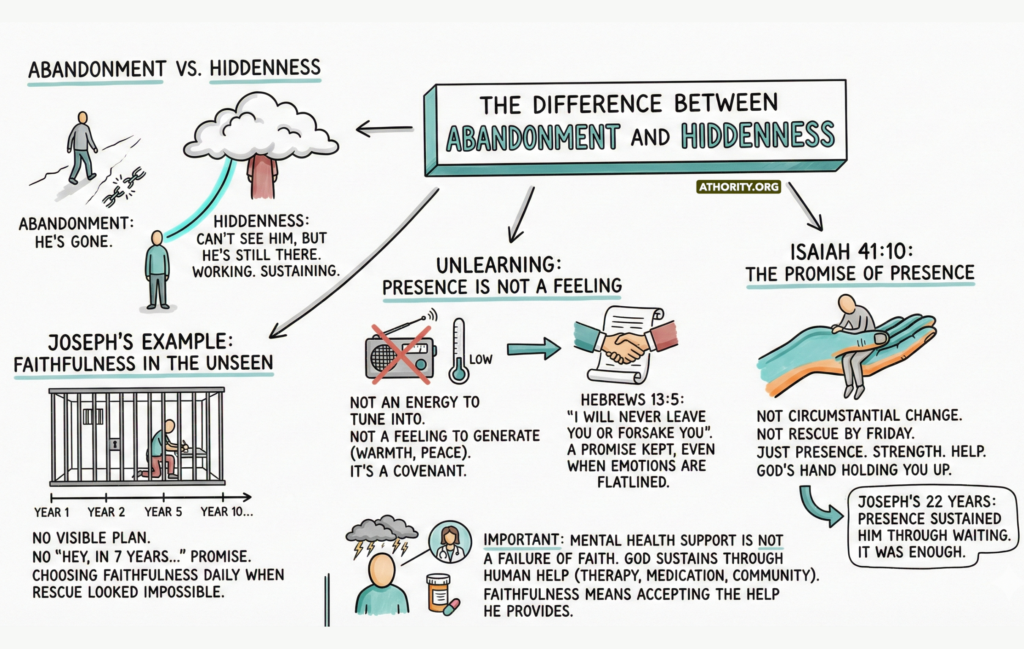
Abandonment means He’s gone.
Hiddenness means you can’t see Him, but He’s still there. Still working. Still sustaining. Still orchestrating things you can’t see yet and may never understand in this lifetime.
I had to unlearn that God’s presence isn’t an energy you have to tune into or a feeling you have to generate. It’s a promise He keeps whether you feel it or not. I came from a background where I thought spiritual experiences were supposed to feel like something… warmth, peace, alignment, a sense of confirmation. So when I felt nothing, I assumed I was doing something wrong or that God had withdrawn.
But God’s presence isn’t a spiritual high. It’s a covenant. It’s Him saying “I will never leave you or forsake you” (Hebrews 13:5, NLT) and keeping that promise even when your emotions are flatlined and your prayers feel like they’re bouncing off the ceiling.
Joseph didn’t see the plan while he was in prison. He couldn’t. There was no moment where God appeared and said, “Hey, don’t worry, in seven years you’ll be second-in-command of Egypt and you’ll save your whole family from famine.” Joseph just had to get up every day in that prison and choose faithfulness when rescue looked impossible.
Year one. Year two. Year five. Year ten. Getting up. Doing his work. Trusting… or maybe just choosing not to abandon the God who seemed to have abandoned him.
Scripture says: “Don’t be afraid, for I am with you. Don’t be discouraged, for I am your God. I will strengthen you and help you. I will hold you up with my victorious right hand” (Isaiah 41:10, NLT).
Notice what’s promised here. Not circumstantial change. Not rescue by Friday. Not even an explanation. Just presence. Strength. Help. God’s hand holding you up when you can’t stand on your own anymore.
That’s what Joseph had for twenty-two years. And somehow, it was enough. Not because the circumstances changed quickly. They didn’t. But because God’s presence sustained him through the years of waiting.
I need to say something important: If your mental health is deteriorating while you wait, if anxiety, depression, or hopelessness are becoming unbearable, getting professional help is not a failure of faith. God’s sustaining presence doesn’t mean you shouldn’t see a therapist, take medication if needed, or lean on a community for support.
Sometimes God sustains us through the very human help He provides. Faithfulness doesn’t mean white-knuckling through mental health crises alone. It means staying connected to Him while also accepting the help He places in front of you.
What To Do When You’re Too Tired To Keep Going
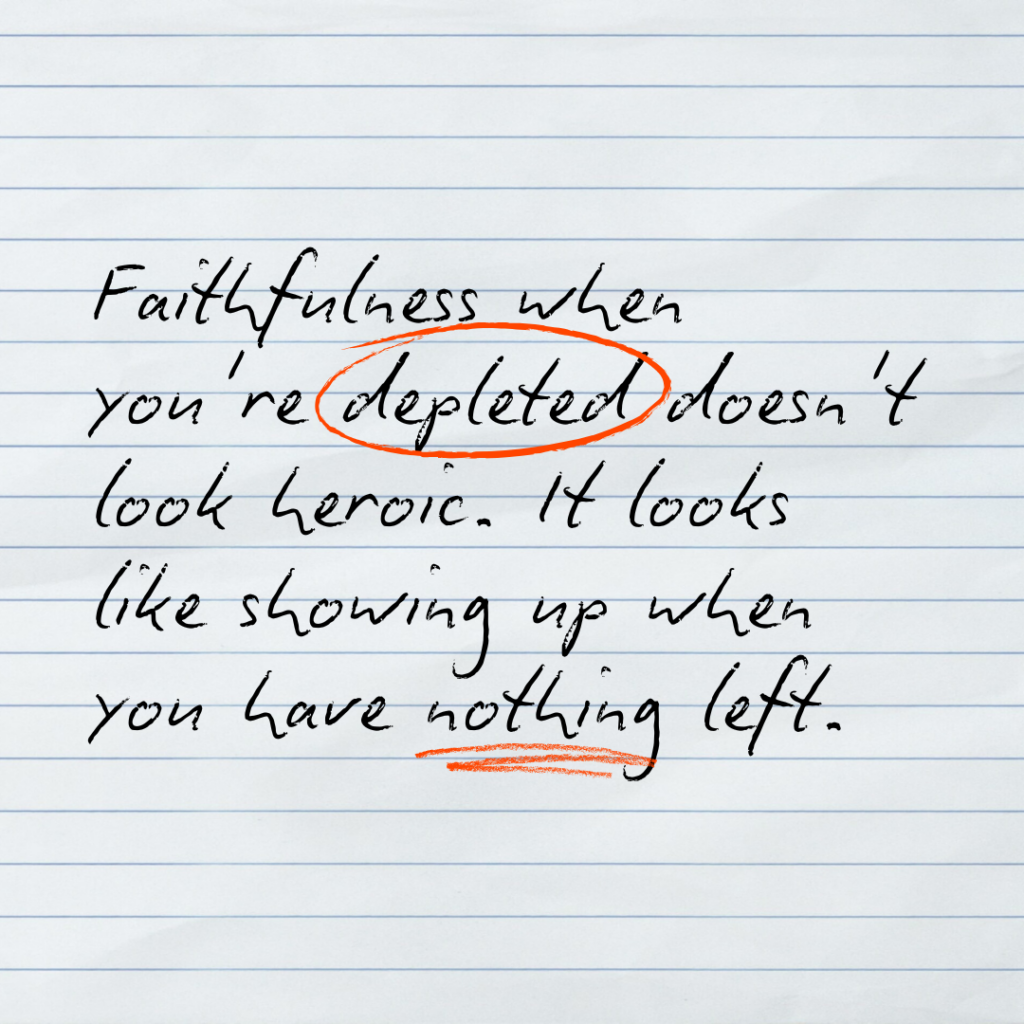
Faithfulness when you’re depleted doesn’t look heroic.
It looks like showing up when you have nothing left.
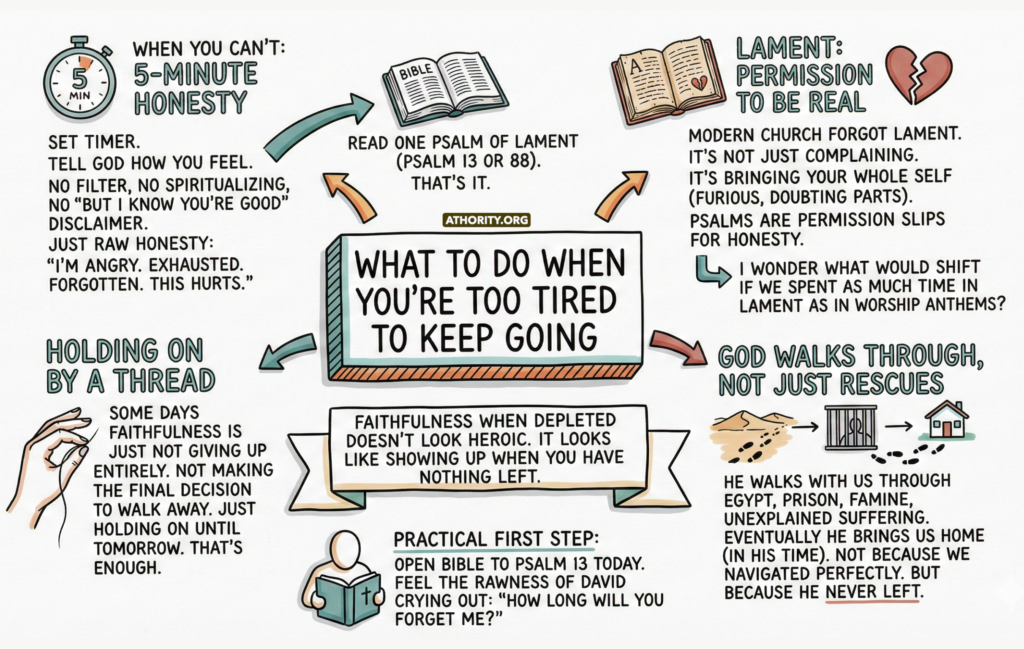
Some days, faithfulness is this: Set a timer for 5 minutes. Tell God exactly how you feel. No filter, no spiritualizing, no “but I know You’re good” disclaimer. Just raw honesty. “I’m angry. I’m exhausted. I feel forgotten. This hurts.” Then read one Psalm of lament. Psalm 13 or Psalm 88. That’s it.
(There’s something about lament that the modern church has forgotten. It’s not just complaining to God. It’s bringing your whole self to Him. Even the parts that are furious and doubting and barely hanging on. Especially those parts. The Psalms are more than ancient poetry… they’re permission slips for honesty. I wonder what would shift if we spent as much time in the lament psalms as we do in the worship anthems.)
Some days you can’t even do that. Some days faithfulness is just not giving up entirely. Not making the final decision to walk away. Just holding on by a thread until tomorrow.
That’s enough.
You don’t have to be victorious. You don’t have to have your breakthrough testimony ready to share. You don’t have to pretend you understand why God is taking so long.
You just have to not let go completely.
Because I’m learning slowly ,that God doesn’t just rescue us from the pit. He walks with us through Egypt, through prison, through famine, through years of unexplained suffering. And eventually (in His time, not ours) He brings us home.
Not because we navigated perfectly. But because He never left.
If you need help taking a practical first step: Open your Bible to Psalm 13 today. Read it and let yourself feel the rawness of David crying out “How long will you forget me?” You can read it free at BibleGateway.com if you don’t have a physical Bible nearby. If reading feels impossible right now, sit for five minutes and tell God exactly how you feel. Anger, doubt, exhaustion, all of it. Lament is worship too.
And if you’re struggling with suicidal thoughts or in crisis, please call or text 988 (US), 116 123 (UK), or 1-833-456-4566 (Canada). This moment will not last forever.