I keep a running tab in my head.
Not intentionally… not even consciously most of the time. But it’s there. A mental ledger of everything I owe. Every time I messed up. Every spiritual failure I’m still paying for. Every reason God might be done with me.
And underneath every entry in that ledger is the same exhausting question: Have I suffered enough yet?
I know what it feels like to lie awake at 2am wondering if God is still punishing you. If the conviction you feel is the Holy Spirit refining you, or if it’s just your anxiety using Scripture against you. If the discomfort you’re experiencing is growth… or just the natural consequence of being the kind of person who needed this much fixing in the first place.
Maybe you know this cycle.
You mess up. You feel guilty. You repent (again). You promise to do better. You feel okay for a while. Then the guilt creeps back in, whispering that the repentance didn’t really count. That you didn’t mean it enough. That you’re just lying to God every time you pray because you know you’ll probably fail again anyway.
And the cycle repeats. Exhausting. Relentless. Inescapable.
I used to think that cycle was holiness. That the constant guilt was proof I was taking my sin seriously. That beating myself up was somehow honoring God.
I was wrong.
The Ledger That Never Balances
Here’s what my anxious brain does with grace: it turns it into a transaction.
Sure, Jesus paid for my sins. But have I done enough to prove I’m really sorry? Have I changed enough to deserve what He did? Have I suffered enough consequences to balance the scales?
The answer, according to my internal prosecutor, is always no.
Not enough repentance. Not enough growth. Not enough time spent feeling bad about what I did.
So I keep adding to the ledger. More guilt. More self-punishment. More evidence that I haven’t earned my way back to okay yet.
And the twisted part is that it feels righteous. It feels like I’m being appropriately humble about my sin. Like I’m not letting myself off the hook too easily.
But what if that’s not humility at all?
What if it’s just pride wearing a guilt costume?
The Theology My Anxiety Preaches
My anxiety is a terrible theologian. But it preaches constantly.
It tells me that grace has a limit. That God’s patience runs out. That every failure is evidence I’m not really saved, not really changed, not really His.
It takes verses about sanctification and turns them into threats. “Work out your salvation with fear and trembling” becomes “You’re not working hard enough.” “Be holy as I am holy” becomes “You’ll never be good enough.” “If you love me, keep my commandments” becomes “You don’t really love Him because you keep failing.”
My anxiety takes the voice of the Holy Spirit and twists it into accusation.
And I believed it. For years, I believed that the constant guilt was God. That the relentless self-condemnation was conviction. That I was supposed to feel this way.
But Scripture says something different.
Paul writes: “God saved you by his grace when you believed. And you can’t take credit for this; it is a gift from God. Salvation is not a reward for the good things we have done, so none of us can boast about it” (Ephesians 2:8-9, NLT).
Read that again slowly.
Not a reward. Not earned. Not something you can take credit for.
A gift.
And you can’t owe someone for a gift. That’s not how gifts work.
The Difference I’m Learning to See
Here’s what I’m slowly figuring out: conviction and condemnation are not the same thing.
They feel similar. They both involve discomfort about sin. They both create a desire to change.
But they have completely different sources. And completely different destinations.
Condemnation says: You’re fundamentally broken. You can’t be trusted. You’ll never change. Why does God even bother with you?
Conviction says: This specific thing is hurting you. Let me show you a better way. You’re capable of growth because I’m growing you.
Condemnation is vague and sweeping and immobilizing.
Conviction is specific and directional and empowering.
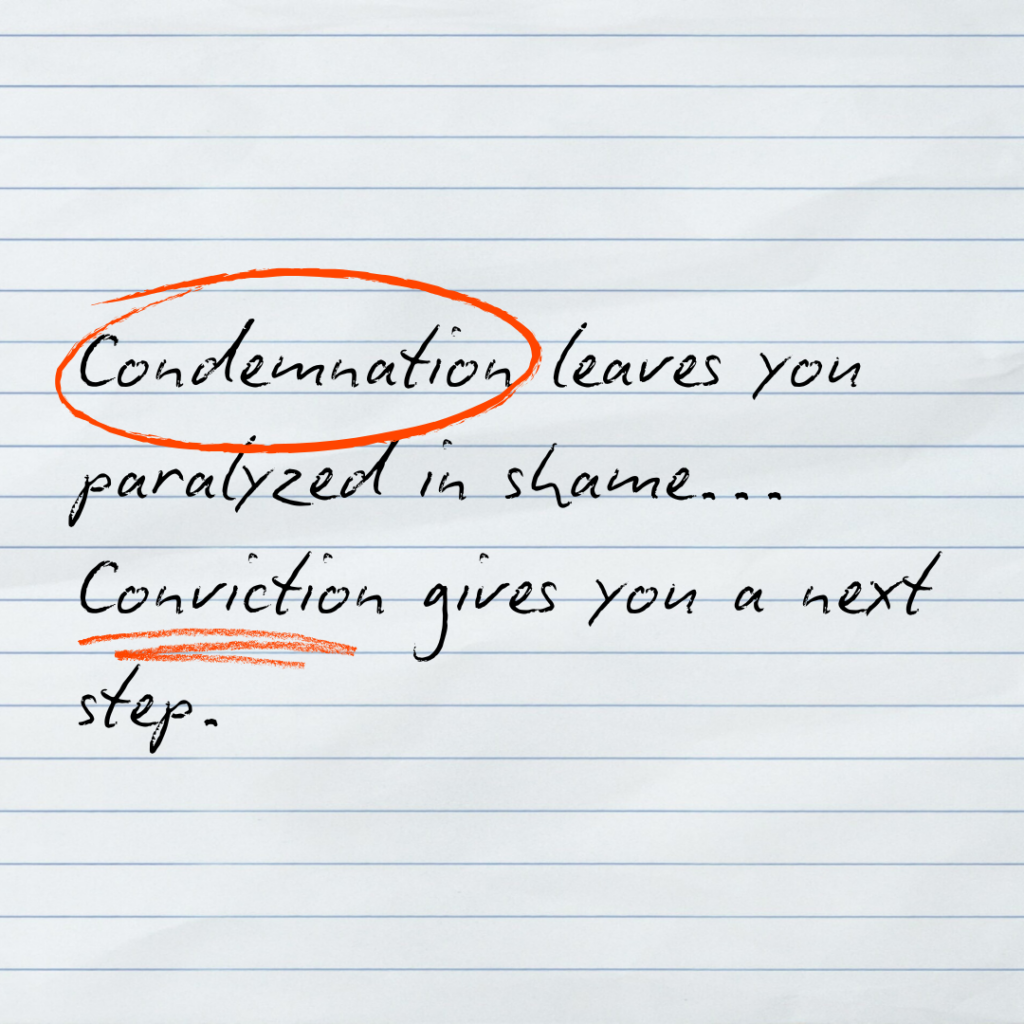
Condemnation leaves you paralyzed in shame, replaying your failures on loop.
Conviction gives you a next step.
I’ve started asking myself a question when the guilt hits at 2am: What is this voice trying to accomplish?
If the answer is just pain with no path forward, it’s not God.
If it names a specific behavior and points toward change, that might be the Holy Spirit.
If it makes me want to hide from God, it’s not from God.
If it makes me want to run toward Him, even ashamed, that’s different.
(I don’t always get it right. Some nights I still can’t tell the difference. But even asking the question has started to loosen the grip.)
The Math That Finally Changed
The writer of Hebrews puts it this way: “For the Lord disciplines those he loves, and he punishes each one he accepts as his child” (Hebrews 12:6, NLT).
For years, I read that verse as a threat. See? God punishes. That’s what I’m experiencing. Punishment.
But look at the logic.
Discipline is presented as evidence of love. Evidence of acceptance. It’s what God does because you’re His child, not to determine whether you’re His child.
The discipline isn’t earning your spot in the family.
It’s proof you’re already in it.
That distinction is everything.
Because if I’m already His, then the discomfort I feel isn’t rejection. It’s not proof that I’ve finally exhausted His patience. It’s not the universe demanding I pay what I owe.
It’s a Father who loves me enough to not leave me stuck in patterns that hurt me.
What I Thought Was Holiness Was Actually Fear
I spent years in a spiritual practice I thought was authentic. Mixing Christian language with other ideas, trusting my own intuition, building something that felt spiritually empowering.
And then the Holy Spirit started convicting me. Gently at first. Then persistently. Eventually, undeniably.
I couldn’t ignore it anymore. I walked away from everything I’d built. Spent over a year in a kind of spiritual wilderness, studying, questioning, trying to figure out what was actually true.
And the whole time, I was terrified.
Terrified that God was angry. That I’d gone too far. That the conviction I felt was proof I was permanently disqualified from grace.
I turned healing into penance. Every uncomfortable realization became evidence I was paying for my mistakes. Every moment of growth felt like earning my way back rather than receiving what had already been given.
I was treating my own transformation like a debt I owed instead of a gift I was receiving.
And that’s the thing about the ledger: it never balances. Because it was never supposed to. The debt was already paid. I just couldn’t stop trying to pay it again.
What If Your Track Record Isn’t the Point?
Maybe you’re reading this with your own ledger running in the background.
The thing you did that you can’t forgive yourself for. The pattern you keep falling back into. The failure that whispers you’re too far gone.
Sweetheart, the penalty was paid.
Not 90% paid with you responsible for the last 10%. Not “paid but with conditions.” Not “paid but you still need to feel bad long enough.” Fully, completely, eternally paid.
The question isn’t whether you’ve suffered enough to earn forgiveness.
The question is whether you’ll accept the forgiveness that’s already been given.
That’s harder than it sounds. Accepting grace means releasing the ledger. It means admitting that your self-punishment isn’t actually accomplishing anything except exhausting you. It means trusting that Christ’s blood was sufficient even for that thing you did.
I’m still learning this. Some days I believe it. Some days the ledger starts running again and I have to consciously set it down.
But God’s discipline and God’s rejection are not the same thing.
You can expect His correction without fearing His abandonment.
You can experience conviction without drowning in condemnation.
He’s not preparing a case against you. He’s preparing you. For something. For healing. For purpose. For the life you were actually made for.
That’s not punishment.
That’s love.
The Difference Changes Everything
When I finally started to believe that my penalty was paid (not just know it theologically, but actually let it reshape how I see myself), something shifted.
I stopped reading every hard season as punishment.
I started seeing correction as evidence that I belong rather than proof that I don’t.
The healing work I’m doing? It’s not to make me right with God. It’s happening because I’ve been made right with God.
The growth edges, the uncomfortable realizations, the patterns God keeps surfacing? Not debt collection. Investment.
He’s not tolerating me while I work off what I owe.
He’s loving me enough to not leave me where I am.
(Some days I believe that. Some days I don’t. Maybe that’s where you are too. And maybe… maybe that’s okay. Maybe the work is learning to receive grace even on the days we can’t feel it.)
If you want to take a next step: Open your Bible to Hebrews 12:5-11 and read it slowly. Just sit with what it says about how God treats the children He loves.
But maybe that feels like too much right now. Maybe opening Scripture still feels loaded, or you’re not sure you can trust what you’ll find there.
Then try this instead: Notice one moment today where something uncomfortable pushed you toward growth. A conversation that revealed a blind spot. A consequence that forced a change. An internal conviction that wouldn’t let you stay comfortable.
And ask yourself, What if that wasn’t punishment? What if that was a Father who loves me enough to prepare me for something?
That’s it. That’s the beginning.
(There’s something in those Hebrews verses about God disciplining us so we can “share in his holiness” that I keep thinking about. What if the uncomfortable growth you’re experiencing isn’t evidence you haven’t arrived… but proof that He sees you as worth the investment? I wonder what that passage looks like when you read the whole thing in context. What else might be there that changes how we see this?)