I was good at what I did.
That’s the part that still makes my stomach drop. Not that I was lost, but that I was effective. I had people who trusted me. Who came back. Who told their friends I’d helped them find clarity, peace, connection with God.
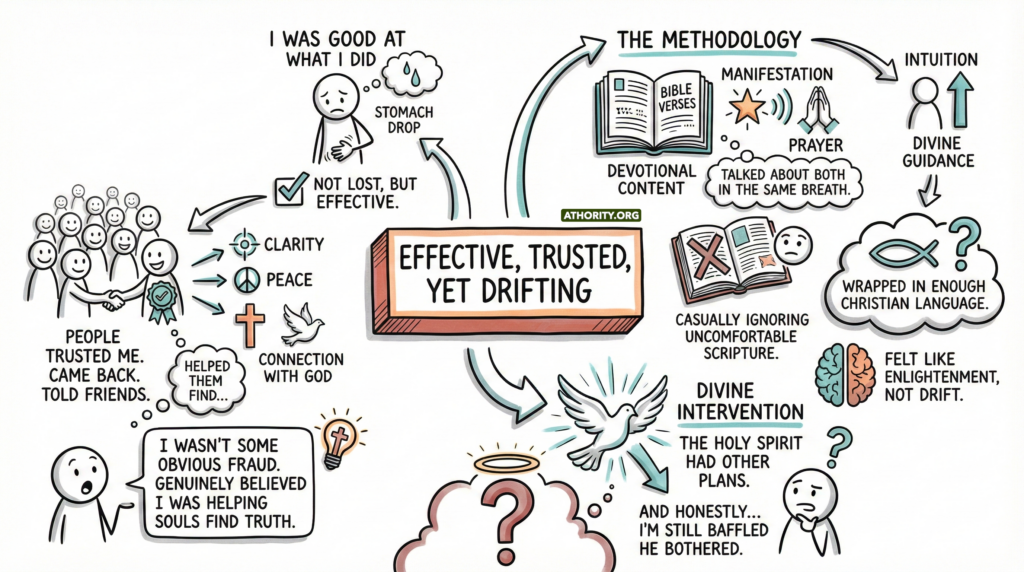
I wasn’t some obvious fraud. I genuinely believed I was helping souls find truth.
I created devotional content with Bible verses alongside practices that weren’t exactly… orthodox. I talked about manifestation and prayer in the same breath. I encouraged people to trust their intuition as divine guidance while casually ignoring the parts of Scripture that made me uncomfortable. All of it wrapped in enough Christian language that it felt like enlightenment, not drift.
The Holy Spirit had other plans. And honestly… I’m still baffled He bothered.
The Math That Doesn’t Add Up
Here’s what I know, I can trace the actual harm. I was blending Christian language with practices that pulled people away from trusting Christ alone, even though I didn’t see it that way at the time.
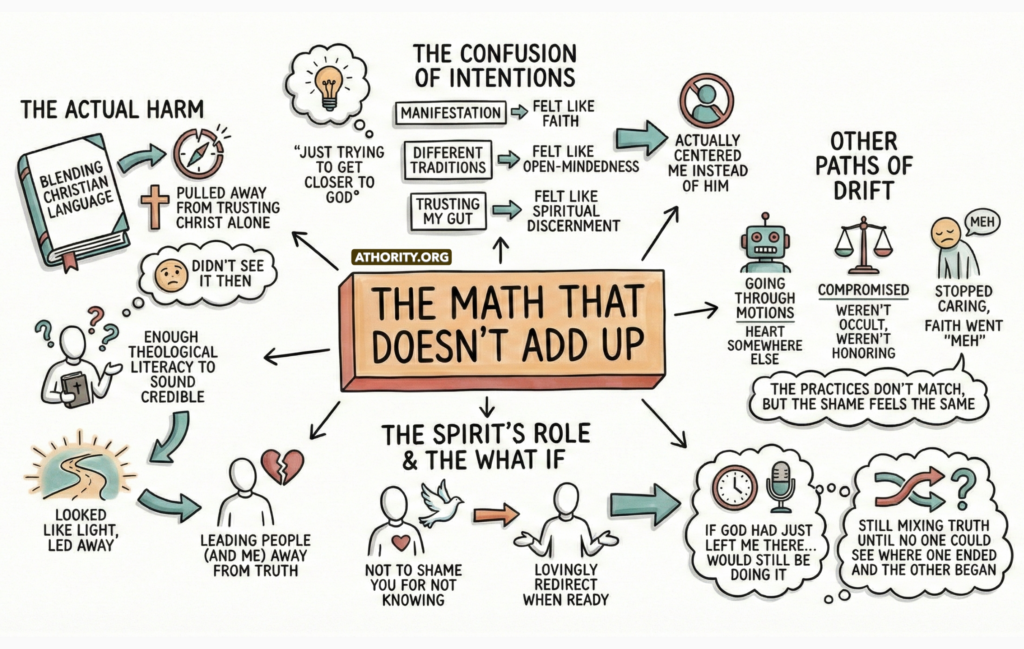
I had enough theological literacy from my Christian upbringing to sound credible, enough genuine seeking to be convincing. I used all of it to build something that looked like light but was leading people (including me) away from the truth we were desperately seeking.
Maybe you’re reading this thinking, “But I was just trying to get closer to God.” I know. That’s what made it so confusing for me too. Manifestation felt like faith. Taking what resonated from different traditions felt like open-mindedness. Trusting my gut feeling felt like spiritual discernment. I genuinely believed I was drawing closer to God while using approaches that actually centered me instead of Him.
Maybe your story looks different. Maybe you never touched a tarot deck but you drifted through years of going through the motions, saying the right things while your heart was somewhere else entirely. Maybe you compromised in ways that weren’t occult but weren’t exactly honoring either. Maybe you just… stopped showing up. Stopped caring. Let your faith go “meh” while telling yourself you’d get serious about it eventually.
The practices don’t have to match for the shame to feel the same.
I’m not saying you’re stupid or that you were deliberately trying to deceive anyone. I’m saying I understand how sincerely you can believe you’re doing the right thing while heading in the wrong direction. The Spirit’s job isn’t to shame you for not knowing. It’s to lovingly redirect you when you’re ready to see it.
If God had just… left me there, I would still be doing it. Still posting content. Still offering spiritual counsel I had no authority to give. Still mixing truth with other practices so seamlessly that no one (including me) could see where one ended and the other began.
When The Conviction Started
It wasn’t dramatic, but it was… persistent.
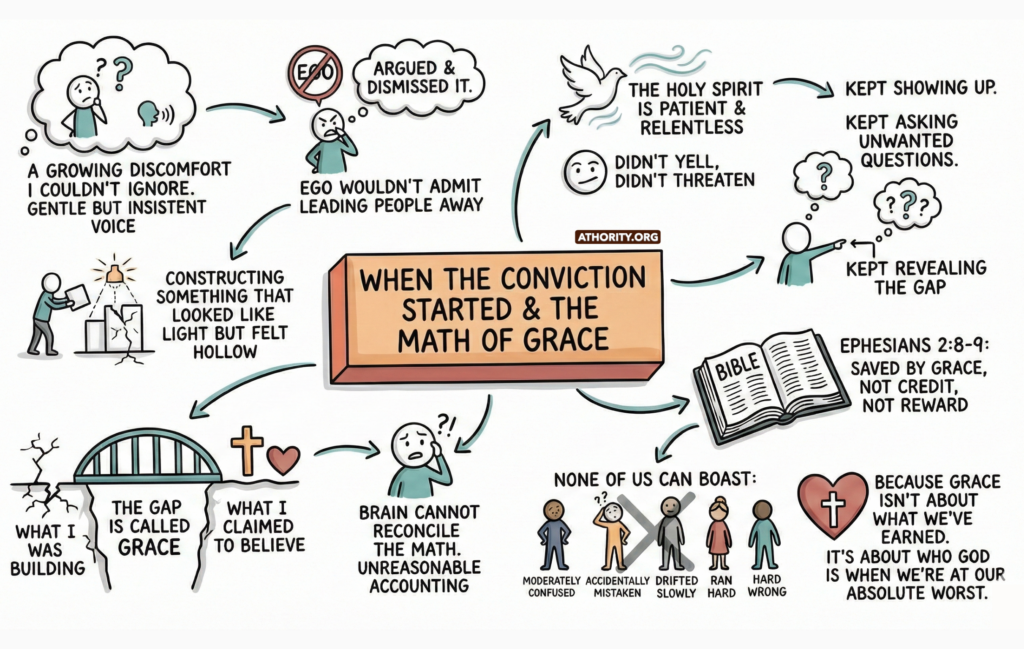
A growing discomfort I couldn’t ignore. Like a gentle but insistent voice asking me to reconsider what I was doing. At first I argued with it. Tried to dismiss it. My ego wouldn’t let me admit that I might be leading people away from truth rather than toward it. But the internal pressure kept building, making me realize I was constructing something that looked like light but felt increasingly hollow.
The Holy Spirit is patient and relentless in the best way. He didn’t yell. He didn’t threaten. He just… kept showing up. Kept asking the questions I didn’t want to answer. Kept revealing the gap between what I was building and what I claimed to believe.
That gap is called grace.
And my brain genuinely cannot reconcile the math.
The reason grace baffles me isn’t because I’m performing some spiritual exercise in humility. It’s because by any reasonable accounting, I should still be carrying the weight of that harm. But Scripture doesn’t traffic in reasonable accounting: “God saved you by his grace when you believed. And you can’t take credit for this; it is a gift from God. Salvation is not a reward for the good things we have done, so none of us can boast about it” (Ephesians 2:8-9, NLT).
None of us.
Not the moderately confused. Not the accidentally mistaken. Not the ones who drifted slowly. Not the ones who ran hard in the wrong direction.
None of us can boast.
Because grace isn’t about what we’ve earned. It’s about who God is when we’re at our absolute worst.
If You Think Your Track Record Disqualifies You
I need you to hear this carefully: if you’re reading this thinking, “That’s nice for her, but you don’t understand what I’ve done,” I actually do understand.
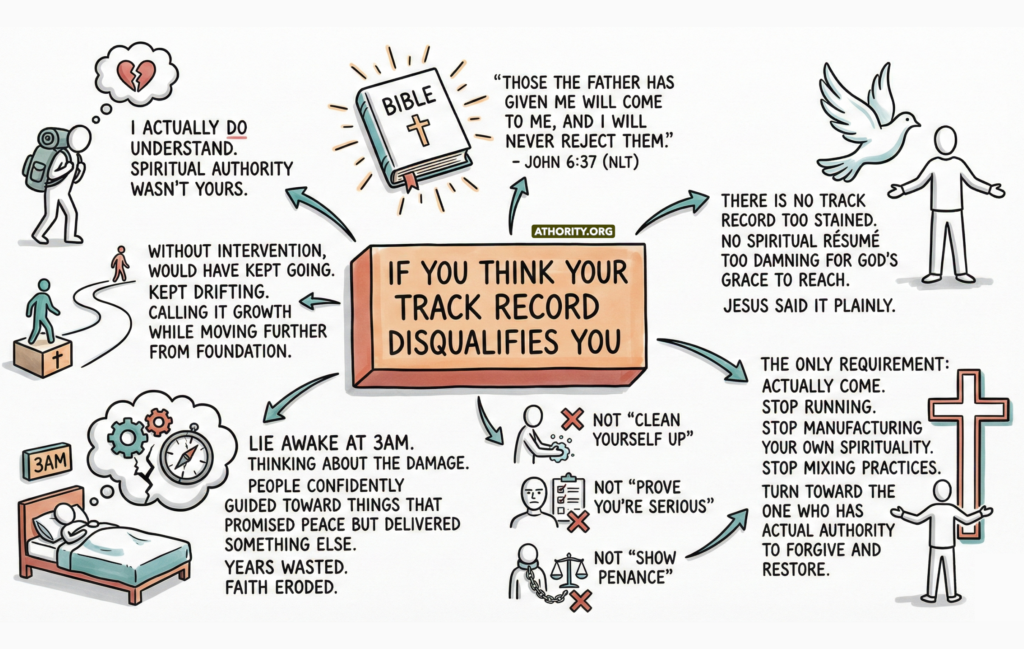
Maybe not your specific story. But I know what it feels like to realize you operated in spiritual authority that wasn’t yours to claim. I know the shame of understanding that without God’s intervention, you would have just kept going. Kept building. Kept drifting. Kept calling it growth while actually moving further from the foundation you once had.
I know what it’s like to lie awake at 3am thinking about the damage. The people you confidently guided toward things that promised peace but delivered something else entirely. The years you wasted. The faith you let erode.
And here’s what I learned in that place:
There is no track record too stained. No spiritual résumé too damning for God’s grace to reach.
Jesus Himself made this clear. Not as a metaphor. Not as encouragement for the moderately sinful. He said it plainly: “However, those the Father has given me will come to me, and I will never reject them” (John 6:37, NLT).
Read it again.
I will never reject them.
Not “Come back when you’ve cleaned yourself up.” Not “Prove you’re serious first.” Not “Show me you’ve done enough penance for the harm you caused.”
The only requirement is that you actually come. That you stop running. Stop trying to manufacture your own spirituality. Stop mixing practices that feel enlightening but leave you more disconnected than before. And turn toward the One who has actual authority to forgive and restore.
The Uncomfortable Company of Grace
What makes grace so scandalous is that it shouldn’t work this way.
My human brain operates on merit. On earning. On getting what you deserve. Grace demolishes that entire framework. It makes no logical sense, which is precisely why it’s so powerful.
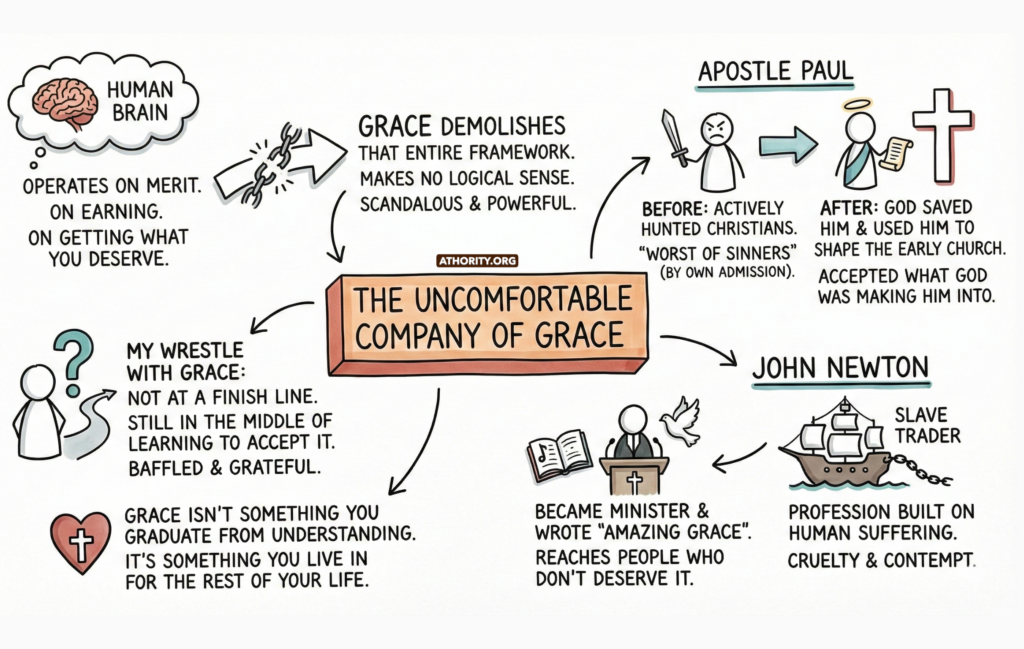
The apostle Paul knew this. Before his conversion, he didn’t just make mistakes, he actively hunted Christians. Approved their executions. Was, by his own admission, the worst of sinners. And yet God not only saved him but used him to shape the early church in ways that still echo today.
Paul never forgot what he’d been. But he also never let what he’d been stop him from accepting what God was making him into.
Or consider John Newton, a violent blasphemer and slave trader. His profession was literally built on human suffering. His lifestyle marked by cruelty and contempt for God. Most people would write him off as beyond redemption.
But grace doesn’t consult most people.
Newton became a minister of the gospel and wrote “Amazing Grace,” a song that acknowledges exactly what he understood, grace is amazing precisely because it reaches people who don’t deserve it.
(And this is where I wrestle with writing about grace while still not fully grasping it. I’m not standing on the other side of some finish line explaining how it all makes sense now. I’m still in the middle of learning to accept what’s been offered. Still struggling to believe I’m worthy of being held by Jesus rather than condemned by Him. Still working on leading with my redemption rather than my sin. Maybe that’s the point. Grace isn’t something you graduate from understanding. It’s something you live in, baffled and grateful, for the rest of your life.)
The Father Who Runs
When I first started coming back to Christianity after leaving behind that space where I’d been mixing Christianity with other spiritual practices, I thought I’d need to prove myself. Show up with evidence of spiritual progress. Demonstrate that I’d changed enough to deserve another chance. Spend years earning my way back from the harm I’d caused.
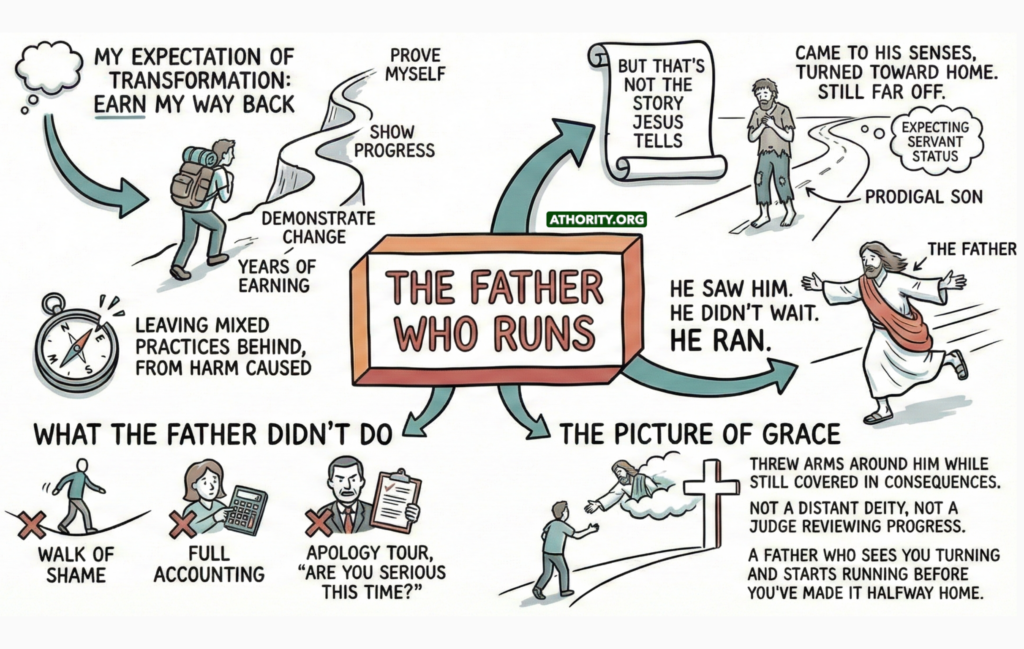
That’s how transformation works in our heads. We earn our way back.
But that’s not the story Jesus tells.
When the prodigal son finally came to his senses and turned toward home, fully expecting to be demoted to servant status at best, his father saw him while he was still far off.
And the father didn’t wait.
He didn’t make his son complete the walk of shame. Didn’t require a full accounting or an apology tour. Didn’t say “let me see if you’re serious this time.”
He ran.
He ran toward his son and threw his arms around him while the son was still covered in the consequences of his choices.
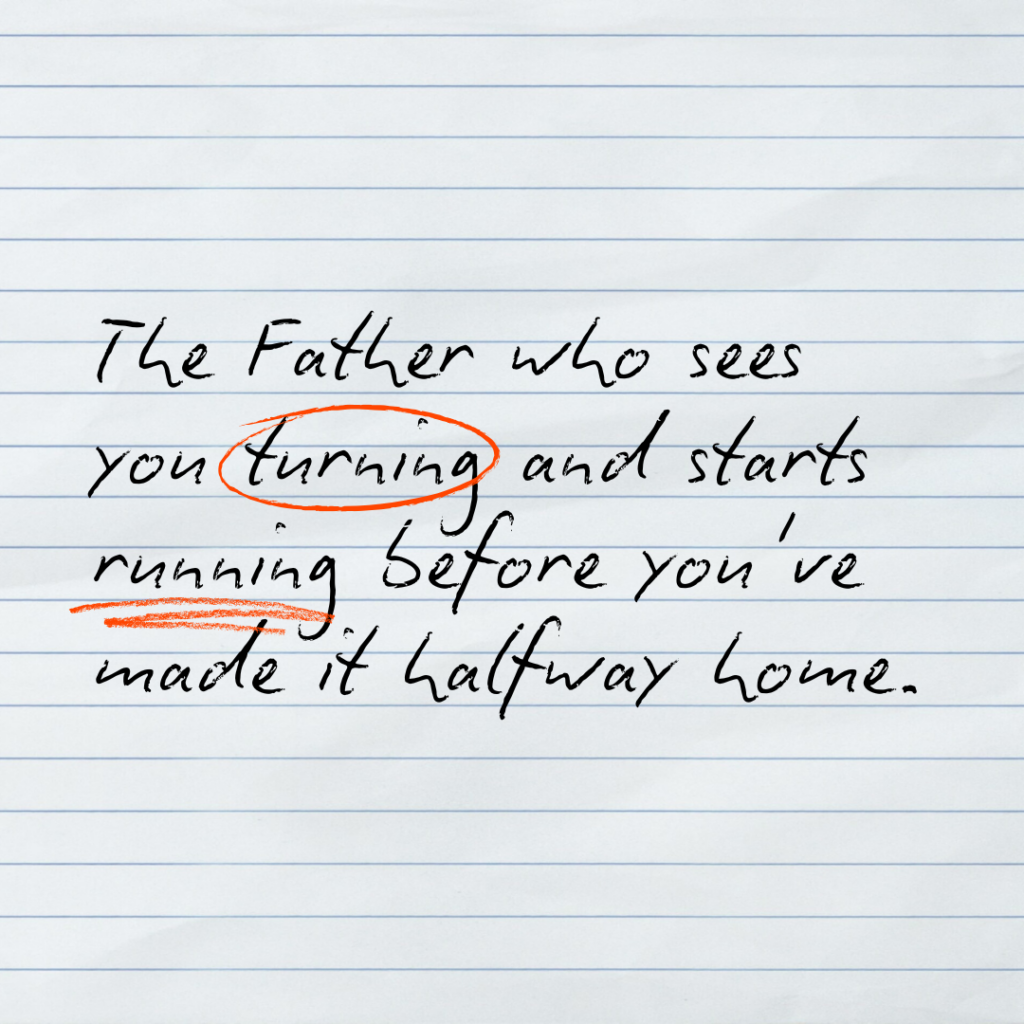
That’s the picture of grace. Not a distant deity waiting for you to get your act together. Not a judge reviewing your reformation progress. But a Father who sees you turning and starts running before you’ve made it halfway home.
But What About Holiness?
Here’s what confused me for years (and if you grew up in a church that emphasized purity and obedience, this might be confusing you too): Yes, we’re called to be holy. Yes, God’s standard is perfection. Scripture is clear about this.
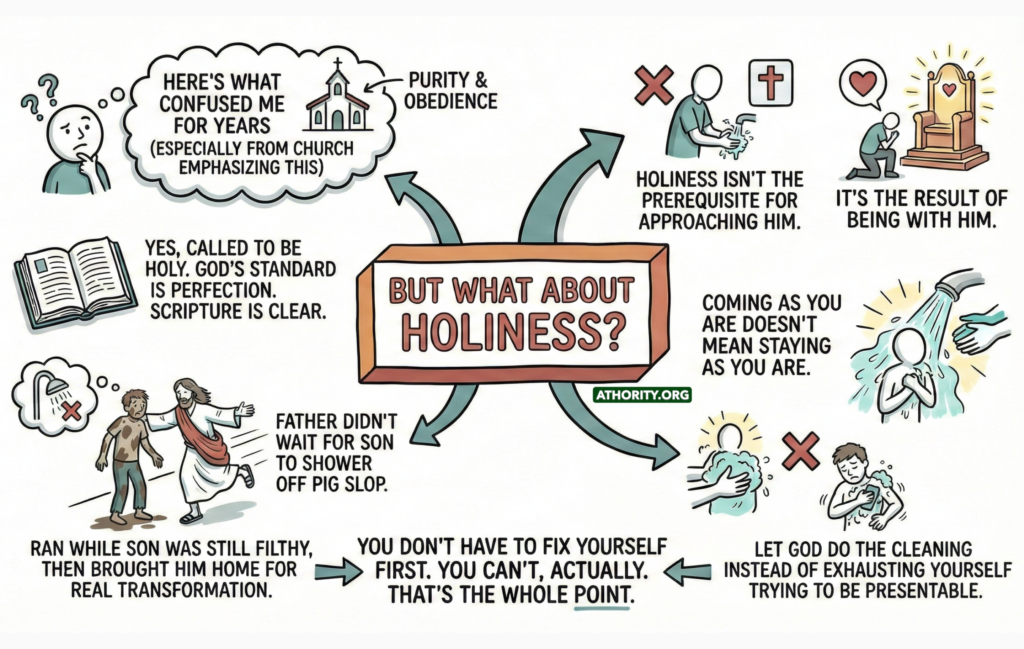
But holiness isn’t the prerequisite for approaching Him. It’s the result of being with Him.
The father in Jesus’s story didn’t wait for his son to shower off the pig slop before running to embrace him. He ran while his son was still filthy, then brought him home where the real transformation could begin. Coming as you are doesn’t mean staying as you are. It means letting God do the cleaning instead of exhausting yourself trying to be presentable enough to deserve His presence.
You don’t have to fix yourself first. You can’t, actually. That’s kind of the whole point.
Where Would We Be?
So here’s the question that keeps me up at night: Where would I be without God’s grace?
I know the answer.
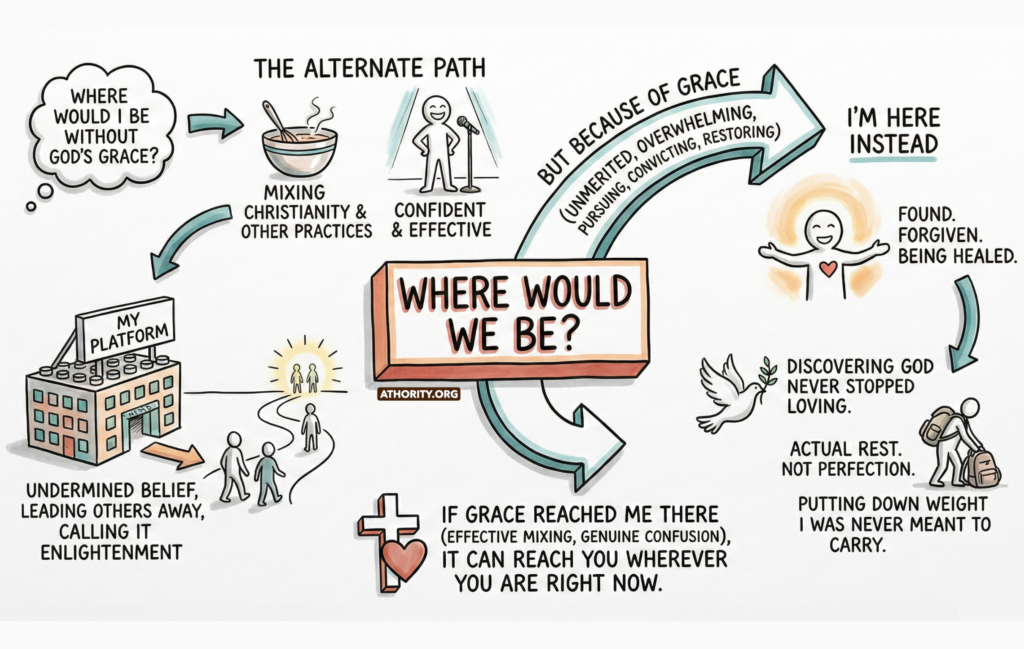
I would still be in that space, mixing Christianity with whatever practices felt spiritually satisfying. Not crisis-ridden or doubting, but confident and effective. I’d still be blending Christian language with approaches that undermined what I claimed to believe. Still building my platform. Still leading others away from the truth they were desperately seeking, all while convinced I was helping them find enlightenment.
But because of grace (unmerited, overwhelming, pursuing, convicting, restoring grace) I’m here instead.
Found. Forgiven. Being healed.
Discovering that the God I once confidently misrepresented never stopped loving me, even when I was actively mixing His truth with other practices and calling it wisdom. And here’s what I didn’t expect: the peace. Not perfection, not having it all figured out, but actual rest. The kind that comes from finally putting down weight I was never meant to carry.
If grace reached me there, in that place of effective spiritual mixing and genuine confusion about what I was building, it can reach you wherever you are right now.
What You Do With This
Here’s what you need to understand, whatever you’ve done, whatever you’ve practiced, whatever you let slide or walked away from or mixed together hoping it would lead somewhere good… none of it is beyond the reach of a God who specializes in redeeming the irredeemable.
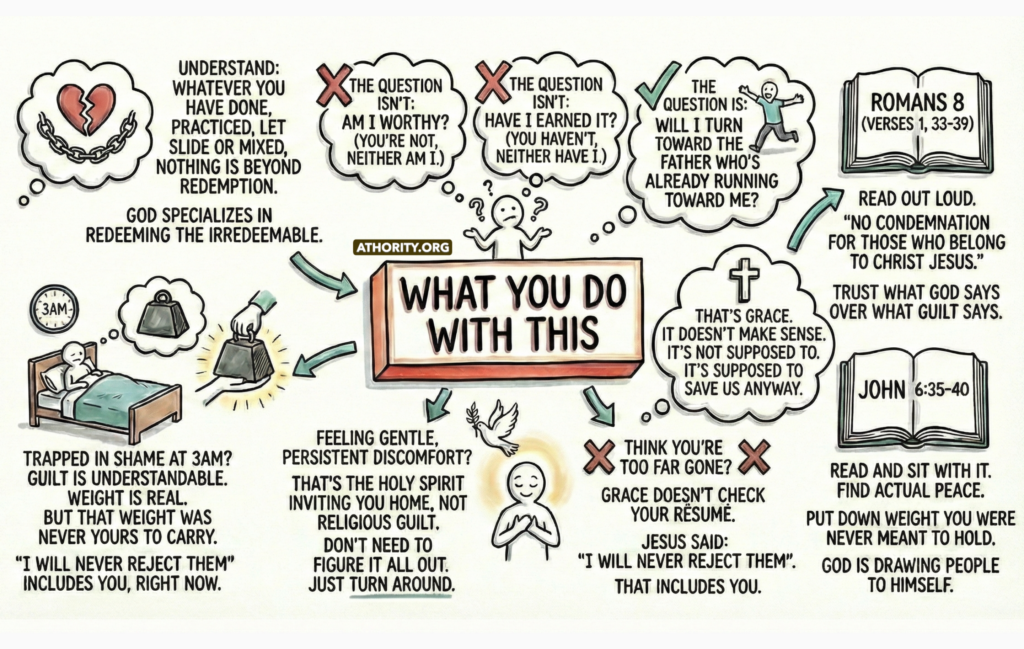
The question isn’t whether you’re worthy. (You’re not, and neither am I.)
The question isn’t whether you’ve earned it. (You haven’t, and neither have I.)
The question is whether you’ll stop running and turn toward the Father who’s already running toward you.
If you’re trapped in the shame of your past, if you wake up at 3am thinking about the damage you caused or the years you wasted, I need you to know: that guilt is understandable. The weight is real. But that weight was never yours to carry. “I will never reject them” includes you, right now, exactly as you are.
If you’ve been feeling that gentle, persistent discomfort, that sense that something isn’t quite right with the spiritual framework you’ve been building… I need you to know: that’s not religious guilt trying to control you. That might be the Holy Spirit inviting you home. You don’t need to have it all figured out. You don’t need to understand exactly where you went wrong. You just need to turn around.
If you’re reading this and thinking you’re too far gone, that you’ve drifted too far, that your spiritual track record disqualifies you, I need you to know: I thought that too. I was wrong. Grace doesn’t check your résumé before it reaches you.
Jesus said it clearly: “I will never reject them.”
That includes you. Right now. Exactly as you are, with all the mess and confusion and harm.
That’s grace.
It doesn’t make sense. It never will.
It’s not supposed to.
It’s supposed to save us anyway.
Here’s what helped me when the guilt kept showing up: I started reading Romans 8 out loud. Not analyzing it. Not mystifying about it. Just reading verses 1, 33-39 until they started sinking in. “There is no condemnation for those who belong to Christ Jesus.” That’s not theory. That’s your actual reality if you’ve turned to Him. On the days I couldn’t believe it, I read it anyway. Sometimes accepting grace is less about feeling it and more about choosing to trust what God says about you more than what your guilt says about you.
If you need help taking a practical first step: Open your Bible and read John 6:35-40. Just read it and let yourself sit with what Jesus says about who He accepts. What I found when I did this is actual peace. The kind that makes you realize you’ve been carrying weight you were never meant to hold. You might be surprised by what else is in that passage (there’s something there about God drawing people to Himself that might change how you see your whole journey back). If you don’t have a Bible, you can read it free online at Bible Gateway.