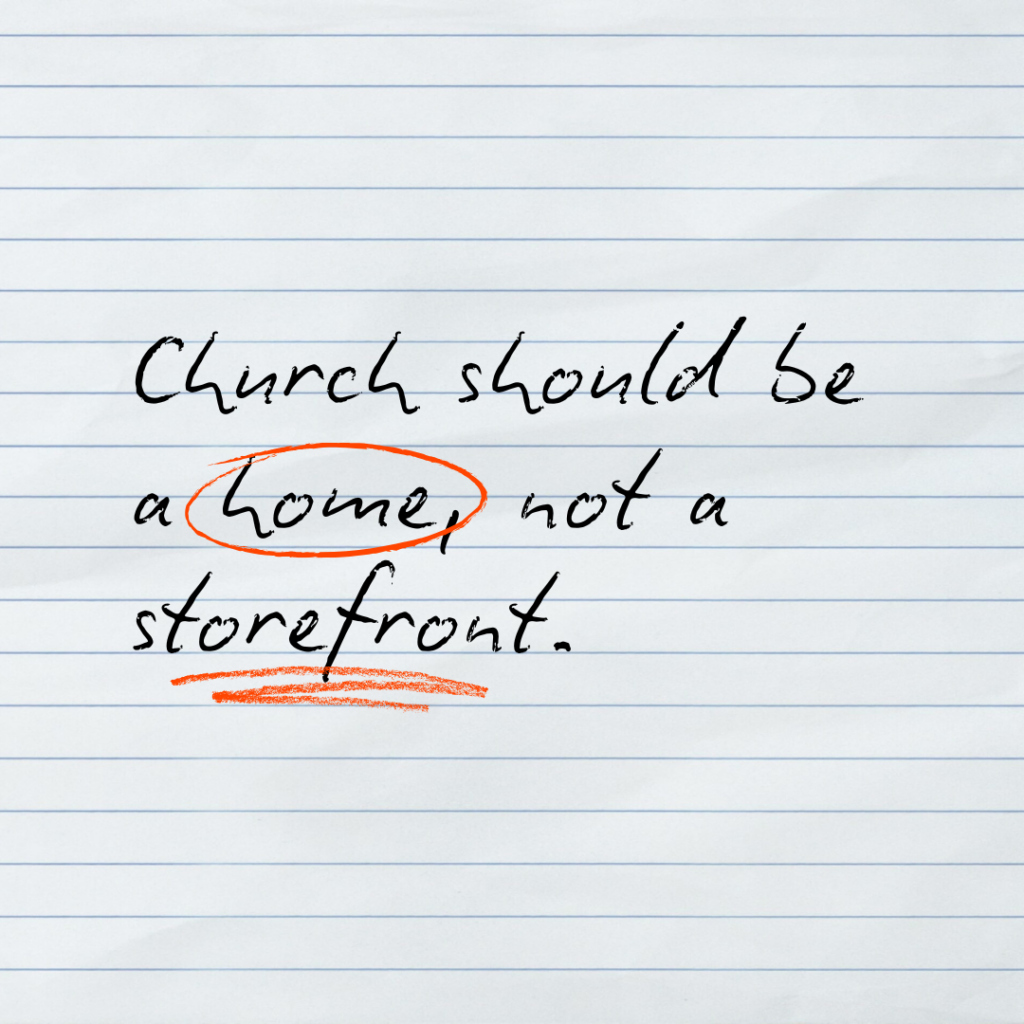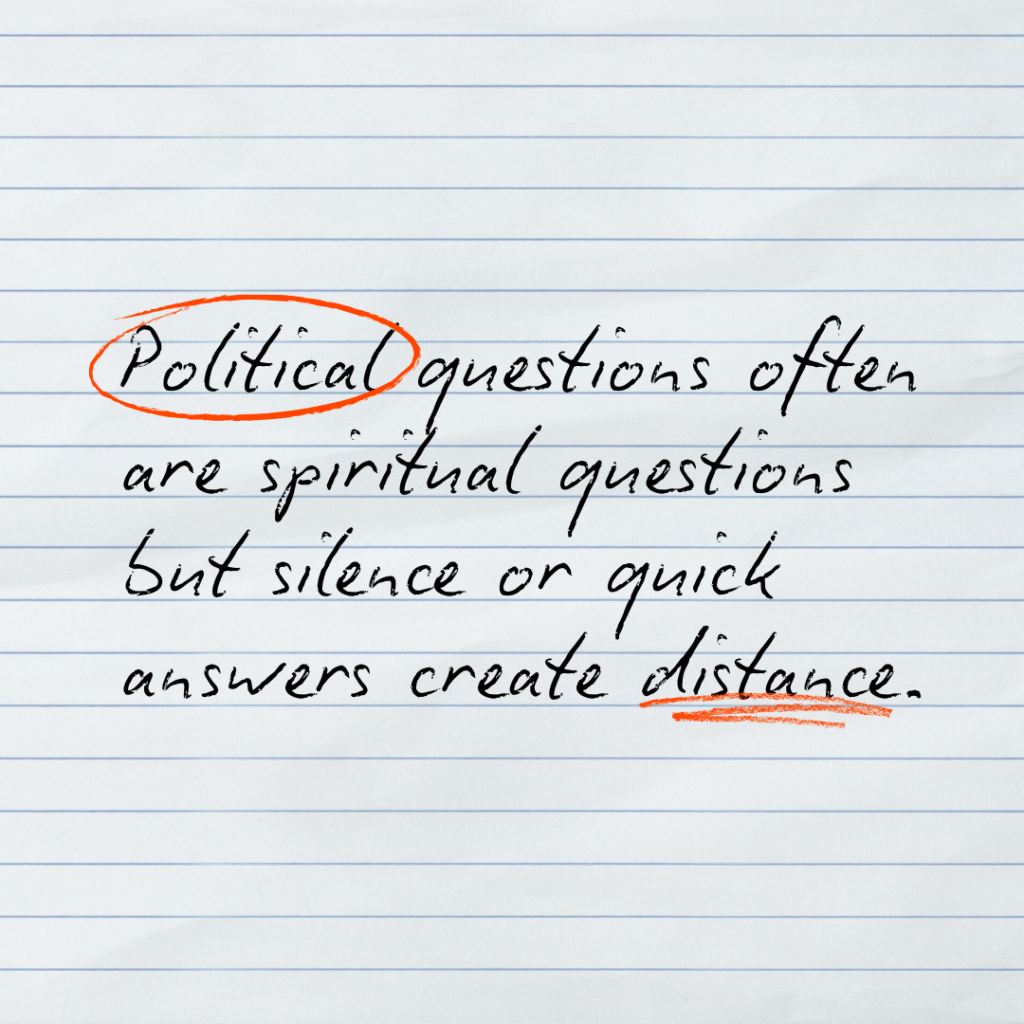
You’ve seen it.
The eye rolls during the sermon. The questions that feel more like challenges than curiosity. The gradual silence where there used to be engagement. Maybe they’ve started saying things like “I’m spiritual, just not religious” or “I believe in God, I just don’t think church is for me.”
And somewhere in your chest, there’s this specific, terrible dread. What if this is the beginning of them leaving?
If you’re a parent, a youth leader, a mentor, a pastor… you’ve probably felt this. You’ve invested. You’ve prayed. You’ve tried to create a faith environment that matters. You’ve shown up week after week, navigated awkward conversations, worried about whether you were doing it right. You care deeply about these young people. That’s why you’re reading this in the first place.
And then comes that moment when a teenager asks something you don’t have an easy answer for, and instead of feeling like a teachable moment, it feels like a threat. Like the question itself is the problem. Like if you could provide the right answer, the right response, the right explanation, you could hold the ground and keep them from drifting.
I want to talk to you about why that instinct, however understandable, might be doing the opposite of what you hope.
The Moment Everything Shifts
A youth pastor described watching it happen in real time.
A student he’d known since middle school asked a question about suffering during small group. Something raw and honest about why God let bad things happen to people who didn’t deserve it. Before he could respond, another leader jumped in with a verse and a tidy answer. The room got quiet. The student nodded politely.
And never brought up anything vulnerable again.
That leader wasn’t trying to shut down the conversation. They were trying to help. They cared about this kid. They wanted to give her something solid to hold onto.
But what got communicated wasn’t “here’s truth to stand on.” What got communicated was “questions like that make us uncomfortable, so let’s move past them quickly.”
The question went underground. And eventually, so did she.
The Number That Should Haunt Us
This is what I can’t stop thinking about: more than a third of young Christians report that they feel unable to ask their most pressing life questions or express doubts within church.
Let that sit for a moment.
Thirty-six percent. These aren’t kids who have already left. These are young people who identify as Christian, who are still technically present, who haven’t yet walked away. And they’re saying, clearly: I don’t feel safe bringing my real questions into this space.
That’s not a faith crisis. That’s a relational one. And it should change how we think about what happens when a young person starts questioning.
Because after years of listening to adults who have walked away, I’ve noticed something: the questions themselves are rarely the issue. It’s where the questions go when they can’t stay in the room that determines everything.
Where Questions Go When They Leave
When a hard question can’t live inside faith community, it doesn’t disappear. It goes somewhere else.
Usually, it goes online. To Reddit threads where anonymity makes vulnerability possible. To TikTok content that offers spiritual guidance without anyone telling them what they can or can’t believe. To Twitter, Discord… to communities built around the shared experience of having been burned by religion and looking for something that feels safer, more personal, more authentically theirs.
The people in these spaces aren’t stupid or deceived. They’re often deeply thoughtful. They’re asking real questions about suffering, about hypocrisy, about how to know if God is real, about whether the church has any credibility left after the scandals and failures they’ve witnessed (or experienced firsthand).
And in those spaces, they’re finding something powerful: permission. Permission to doubt. Permission to question. Permission to construct a spirituality that “speaks to them personally” without anyone correcting them.
The language shifts quickly. “My own path.” “What feels true for me.” “Trusting my gut feeling.” “My spiritual journey.”
Within this new way of thinking, the ultimate authority becomes the individual’s own experience, their inner compass, their intuition. Over half of people in these communities report that they equate the Holy Spirit with their own gut feeling. Not as a metaphor. As a sincere conviction about how spiritual guidance works.
This isn’t rebellion. It’s reconstruction. They’re building something in the absence of what they couldn’t find inside the church. A space where their questions were welcome. A community where doubt wasn’t treated as the enemy of faith.
The Trajectory No One Tells You About
This is the part that should matter to anyone who cares about discipleship: there’s a predictable pattern to this journey. It moves through distinct phases.
First, there’s what you might call construction. This is the phase where a person, having found that their questions weren’t welcome in traditional settings, begins building their own belief system. They step back from the church and elevate personal experience. They take what “speaks to them” from various traditions and create something custom. They feel liberated. Empowered. Finally free to be spiritual on their own terms.
And for a while, it works. The curated spirituality provides meaning. The online communities provide connection. The emphasis on self-trust provides a sense of agency that the church, with its demands for submission and obedience, never offered.
But then… something starts to crack.
Because it turns out that making yourself the final judge of what’s true is exhausting. The same intuition you’ve been taught to trust becomes impossible to distinguish from your anxiety. Your trauma. Your wishful thinking. The people I’ve listened to describe this phase with words like “paralyzed,” “constantly second-guessing,” “unable to tell if it’s real guidance or my fears talking.”
They wanted certainty. They found chaos.
(I know this part intimately. I spent years constructing my own belief system, mixing Christianity with practices that felt more empowering. I kept Jesus, sort of. Trusted my intuition as if it were divine guidance. It felt like spiritual freedom until the Holy Spirit started tapping on my chest with a question I couldn’t shake: What exactly are you building here? What I’d built couldn’t bear weight when the real storms came. More on that in a moment.)
This is the crisis phase. Being your own ultimate authority, which promised freedom, reveals its limits. And the person who once confidently declared they’d find their own path now struggles to trust their own thoughts, feelings, or perceptions.
Where they go from here varies. Some eventually return to structured faith, often through what can only be described as surrender, a willingness to receive guidance rather than manufacture it. Others remain in what I can only call perpetual seeking, cycling endlessly through new practices, new teachers, new explanations, never finding solid ground.
The Question Underneath the Question
So here’s the reframe I want to offer you.
What if the hard questions your teenager or student or mentee is asking aren’t threats to their faith? What if they’re invitations?
Think about what happens when a young person asks a difficult question. They’re saying, in effect: I care enough about this to wrestle with it. I trust you enough to bring this to you. I want to know if there’s room for me here, including the parts of me that aren’t sure.
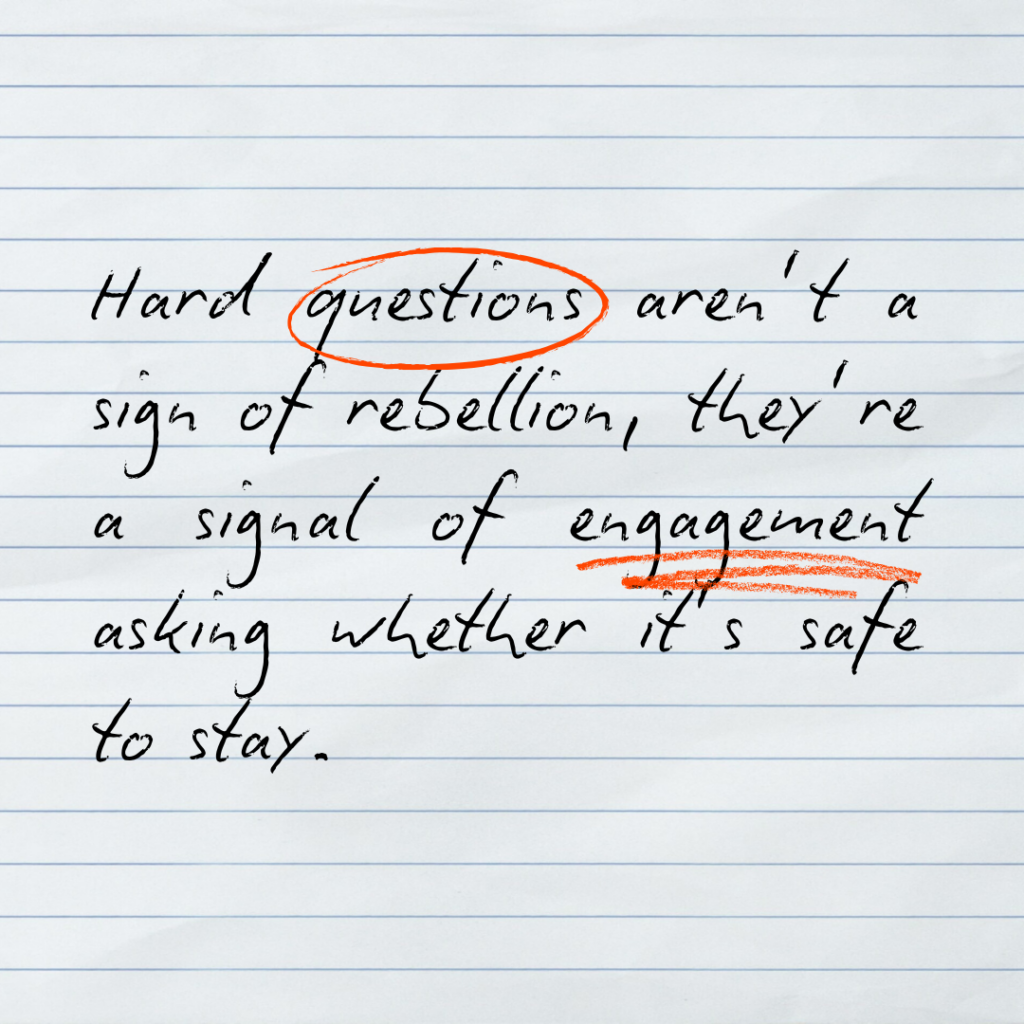
That’s not rebellion. That’s engagement.
The question underneath the question is almost always relational: Am I safe here? Will I still belong if I’m not certain about everything? Is there space for me to think out loud without being corrected or dismissed?
Jesus seemed to understand this. He welcomed people with questions, even uncomfortable ones, even ones that felt like challenges (think about the religious leaders who came to trap him, or Thomas demanding to see the wounds). He didn’t panic when people doubted. He invited them closer: “Put your finger here; look at my hands. Put your hand into the wound in my side. Don’t be faithless any longer. Believe!” (John 20:27, NLT).
Notice the posture. It’s not defensive. It’s not fearful. It’s an open door. A willingness to engage with the mess of honest inquiry rather than demanding pre-formed certainty before the conversation can happen.
But What About the Hostile Questions?
I know what some of you are thinking. And you’re not wrong to think it.
Not every question comes from genuine curiosity. Sometimes the teenager asking “Why is Christianity so hateful?” isn’t really asking about faith. Sometimes they’re testing you. Provoking you. Weaponizing the question to embarrass or deflect or stir up conflict.
I’m not naive about this. It happens.
But even the hostile question often has a genuine question hiding underneath it.
The student asking “Why should I believe a book written by oppressors?” might really be asking “Is there room for someone like me in your faith?” The one sarcastically challenging “Prove God exists” might be wondering “Does anyone sincerely believe this, or is everyone performing?”
(There’s a reason Pastor Jeff on Young Sheldon connects with so many people. He doesn’t win the debates with Sheldon. He doesn’t have perfect answers for every challenge. But he stays kind. He stays present. He treats Sheldon’s relentless questioning as evidence of engagement rather than rebellion. And over time, that consistency matters more than any argument he could win.)
The goal in those first moments isn’t to win. It’s to keep the conversation alive long enough to discover what they’re truly asking. Which requires a posture you might not be used to: listening for longer than feels comfortable before responding.
What Helps
So what does this look like practically? How do you respond differently?
Listen without immediately correcting. I know the instinct. I feel it too. Someone says something that sounds spiritually off, and everything in you wants to fix it before the wrong idea takes root. But the goal in the first moments of a hard question isn’t winning an argument. It’s keeping the conversation alive. If we respond to “I’m not sure I believe in God anymore” by immediately launching into our best case for God’s existence… we might accidentally communicate that this space is for people who already have the right answers, not for people who are still figuring it out.
Admit what you don’t know. This might be the most powerful thing you can do. “I don’t know. That’s a really hard question. Can we figure it out together?” creates more trust than pretending you have answers you don’t have. Young people can smell inauthenticity from a mile away. They’ve grown up with curated social media. They’re looking for someone real.
(I don’t have a perfect track record here. Sometimes I still feel that defensive instinct rise up when someone challenges something I believe deeply. The difference now is that I recognize it as my ego, not as righteous protection of the faith.)
Create space for doubt without panic. Thomas doubted. Job questioned. David lamented (have you read the Psalms lately? They’re brutal in their honesty). The Bible is not a collection of stories about people who had it all figured out. It’s full of wrestling, confusion, anger at God, desperate cries for help. If Scripture has room for that, so should we.
Understand what they’re really asking. Most hard questions are really asking something underneath the surface. “Does God even exist?” might really be asking “Does anyone see my pain?” “Why does the church exclude people?” might really be asking “Is there room for me here if I’m not exactly like everyone else?” “Why do bad things happen?” might really be asking “Will you sit with me in my grief or try to explain it away?”Stay. This might be the most important one. Your consistent presence, not your perfect answers, is what communicates something profound: You belong here. Even with the questions. Especially with the questions.
But What About Truth?
I can hear another objection forming: But what about holding the line? What about truth? Are you saying we should accept whatever questions they bring and never offer anything solid?
No. That’s not what I’m saying.
Creating space for questions doesn’t mean abandoning convictions. It means building the relational container where your convictions can be received.
This is what I learned the hard way: truth spoken without relationship creates defensiveness. Every time. The same words that could transform someone in the context of genuine care will be rejected as judgment when that care hasn’t been established first.
But the opposite is also true: relationship built without truth eventually fails people. If all you do is validate their experience without ever gently pointing toward what might be incomplete in their understanding… you’re not loving them. You’re being comfortable.
The Jesus who welcomed doubters also said “I am the way, the truth, and the life. No one comes to the Father except through me” (John 14:6, NLT). He didn’t soften that claim to make people more comfortable. But he said it in the context of a relationship where his disciples had experienced his love, his presence, his consistency.
You don’t have to choose between compassion and conviction. But the order matters. Relationship first. Then truth has somewhere to land.
What I’m Still Sitting With
How many of the adults I’ve talked to, the ones who spent years constructing elaborate personal spiritualities, the ones who went through crisis and came back, the ones who are still seeking without finding ground to stand on… how many of them might have had a different trajectory if someone had simply said, “That’s a really good question. I don’t know either. Let’s sit with it together.”
Not answered. Not fixed. Held.
There’s this passage in James 5 about the prayer of faith and the role of community in restoration. Specifically: “Confess your sins to each other and pray for each other so that you may be healed” (James 5:16, NLT). Something about how we’re not meant to carry our struggles alone, and how the presence of others who pray with us rather than at us changes something fundamental. I’m still unpacking what that means for how we create communities where questions can breathe without being treated as infections that need to be cured.
Because the questions aren’t going away. This generation has access to more information, more counter-arguments, more alternative perspectives than any generation before them. They can Google their doubts at 1am and find thousands of people who share them.
The question isn’t whether they’ll encounter challenges to their faith. They will. The question is whether, when those challenges come, they’ll have a community that knows how to sit with uncertainty. People who don’t panic when things get messy. Adults who model what it looks like to hold faith and doubt in the same hand.
What would it look like for the church to become the safest place to have the hardest conversations? Not because we have all the answers, but because we worship a God who isn’t threatened by questions.
I don’t have that fully figured out. I’m not sure anyone does.
If You’re Reading This Over Someone’s Shoulder
And if you’re the teenager reading this over your parent’s shoulder… or the young adult who stumbled across this while your mentor scrolls… I see you too.
The questions you’re asking aren’t wrong. Keep asking.
Know that some of us want to hear them. Some of us have been where you are, wondering if there was space for people like us in spaces that seemed to demand certainty we didn’t have. Some of us found our way back to faith not because someone gave us perfect answers, but because someone stayed.
That’s what I’m hoping for you. Not someone who can answer every challenge. But someone who won’t leave when things get complicated.
For Now
I think it starts with this: when they bring you the question that scares you, the one that feels like a threat… take a breath. Remember what’s at stake. And stay.
The questions aren’t the enemy.
And neither are they.
(There’s so much more here. About how the digital spaces that give young people permission to doubt also contribute to their eventual crisis. About what reconstruction looks like when someone’s ready to receive guidance rather than manufacture it. About the whole concept of separating Jesus from the church and whether that’s always harmful or sometimes necessary for healing. I’m still thinking through all of it. Maybe that’s where we’ll go next.)